There has been an announcement last month by Jack Lew that they are replacing Alexander Hamilton on the 10 dollar bill with a woman. This marks the first time that the United States has someone other than a prominent presidential figure or a prominent founding father (think Benjamin Franklin) and I applaud their decision to make a prominent American woman to be displayed on a major denomination (other than the 1 dollar coin which has included Susan B. Anthony and Sacagawea.) Despite the nobility of the idea, it has set off large amounts of controversy, both within the internet community and among prominent people. While Alexander Hamilton's character has both been controversial in the creation of the First National Bank (precursor to today's central bank) and in the recommendation of building a strong central government and a strong commercial sector, which was opposed by the Jeffersonians of the time, who wanted America to be more of the idealized version that De Tocqueville talked about in his magnum opus, Democracy in America, I agree with both the former Federal Reserve chairman, Ben Bernanke and Hamilton biographer, Ron Chernow that Alexander Hamilton should remain on the ten dollar bill.
I understand that he is controversial among certain people, especially among Democrats, about his role in writing the Federalist papers in interpreting in the Constitution and being a precursor of the modern idea of a strong national government that promotes commercial interests versus the common man, he deserves to remain on the 10 dollar bill for the sake of his promotion of the central bank. There has been a huge debate on whether a central bank is needed in such an age of electronic financial innovation, but the latest financial crisis showed that we do need a central bank to mediate the money supply in a complex developed economy, especially in the cases where decisive action is needed in order to curb the excesses within a critical period in order to restore employment levels or inflation levels to more manageable amounts. Alexander Hamilton was ahead of his time in thinking when he promoted the First Bank of the United States and his equally superb ideas in the 'American School', which happened to be one of my first interests in the particular discipline of economics. For all those who criticize Hamilton as being a rash monarchist or a secret supporter of mercantilism, Alexander Hamilton was a great historical figure that influenced both the monetary history of the United States and the economic philosophy of a nation, and he 100% deserves to be kept on the $10 bill.
Showing posts with label Monetary Economics. Show all posts
Showing posts with label Monetary Economics. Show all posts
Wednesday, June 24, 2015

Friday, June 5, 2015
Thoughts on the Austrian business cycle theory
As announced in a blog post couple of weeks ago, I will be undertaking a series of posts on certain business cycle viewpoints and I will try to make my first blog post as concise as possible. As described in the previous post, this specific post will be my thoughts on the Austrian Business Cycle Theory, which will involve a short discussion on Hayek and Mises. Despite the particular lengths of which I could go about this particular theory, I will talk specifically about the basics of the Austrian Business Cycle with an objective point of view.
The Austrian business cycle theory, posited by Carl Menger, Ludwig Von Mises and Friedrich Hayek, has been analyzed and refuted many times. Almost all of the mainstream Neo-Classical and Keynesian economists have rejected all components of the Austrian business cycle theory, which Paul Krugman has previously started a particularly interesting edit war on Wikipedia about. Many prominent economists from several different perspectives, like Paul Krugman and others, believe that the Austrian business cycle theory is seriously flawed in all of its various components. While there are various enormous flaws in the details that the theory postulates, I believe it is wise to ruminate about at how the current policy of low interest rates that various central banks are pursuing is effecting the bigger macro-economic picture and to predict possible future crises by utilizing the Austrian business cycle theory.
To those who are not familiar with the Austrian business cycle theory, it was formulated by three prominent economists, Carl Menger, Ludwig Von Mises and Friedrich Hayek, as a possible explanation of how business cycle works. In the theory postulated by these two well-known gentlemen, it regards business cycles as the unfounded result of improper interests rates set up by central banks, which consequently results in a boom and a bust from this malinvestment of excessive business lending by banks. The theory favors an almost completely laissez-faire approach to the resolution of financial crises caused by what they see as a malinvestment of assets. The favored resolution to the crises could momentarily cause abrupt bank failures, but the resolution that the Austrians prefer is a proper liquidation of all debt and assets. This is a cause for consternation among mainstream economists and they see the Austrian business cycle theory as nonsensical, especially its recommendation for a completely laissez-faire economy. By looking at certain components of the Austrian business cycle theory such as interest rates, empirical research and successful predictions of downturns, we could not completely discount its role in the world of economics.
(For those that are interested in more extensive explanations of the Austrian business cycle theory, here are two links: One by Professor Roger Garrison of Auburn University and another by the Better Living Through Liberty blog. Here is a a more simplistic video explanation by Tyler Cowen, Professor at George Mason University.)
The Austrian business cycle has the most peculiar way of utilizing interest rates to explain the mechanisms of business cycles. This approach combines an unique approach of analyzing interest rates in how they interfere with certain market forces, especially since it predicts that most of the booms and busts created by the fractional banking system comes from tinkering with interest rates. The ABCT believes that by tinkering with certain interest rates, the central banks create the impetus for the crises with the setting of interest rates, usually one that is too low compared to the actual interest rate. The Austrians have mentioned that the last financial crisis was caused by the central bank's insistence on keeping the interest rates lower than what is particularly possible, which might be a feasible analysis of the situation.
Despite the numerous other factors that might discount the ABCT, the theory has proven accurate at utilizing the analysis of interest rates in determining the coming financial crisis. There are obvious pitfalls to the Austrian business cycle theory due to the sheer fact that the theory does not come up with an exact interest rate that is required to not cause a catastrophic recession that happened in 2007-2008. The Austrian business cycle also mentions that interest rates should be decided entirely by the market and it could potentially mitigate long recessions such as the one we just witnessed. There are obvious pitfalls in letting the markets decide the "natural" interest rates and permitting a natural market recovery without central bank intervention. Natural interest rates could potentially cause large fluctuations within the market and could also possibly price out certain people out of the market. (such as low income families, small businesses, etc.) Permitting a natural market recovery could have massive fluctuations in employment and could put a potential strain on the workforce, which could cause acute social problems in society. Despite all of these problems that the ABCT faces, I believe it is wise to look at both the ABCT's record in looking at interest rates and also correct predictions of future economic recessions.
Empirical research conducted by prominent mainstream economists have indicated that the Austrian business cycle theory is not entirely feasible. Let's just compare the opinions of the prominent economists versus the Austrian economists in terms of the conclusions of their empirical research. Let's start with a couple of economists who are rated as libertarian by the mainstream economic community:
Milton Friedman - The late Milton Friedman is considered by everyone as one of the top economists of the last 100 years, with many considering him to be the one of the top two libertarian economists of the last 100 years, along with the Austrian economist, Friedrich von Hayek. Friedman's brand of libertarian economics was not too different than Friedrich von Hayek's theories, but they maintained a lot of the Keynesian semblances that Friedman had been influenced by in his younger economist days, especially in the expansionary benefits of money-financed debt spending.
In Studies in the Quantity Theory of Money, the late Professor Friedman promoted the approach that the monetarists at the Chicago School of Economics had developed and rejected the approach that Hayek theorized in his works denouncing Keynes. From an interview excerpt with Professor Friedman, we can conjecture that Friedman felt that the ABCT was incompatible and has done "a lot of harm to the world". From the observations in his book and from the conversations with the late Professor Friedman, we can accurately conclude that Milton Friedman does not agree with the ABCT in its basic tenets of a completely laissez faire approach and the simplicity that it offers. Despite Milton Friedman's promotion of laissez-faire capitalism, he stops short of endorsing of it as intervention could have potentially saved the banking system during the first Great Depression. I might agree with Professor Friedman's conclusions in requiring some sort of intervention in times of crises, but it's interesting that someone who is one of the mainstream proponents of laissez-faire capitalism would be so overtly critical of market corrections in terms of theory and systemic banking failures.
Tyler Cowen - A more recent and less well-known mainstream economist that has been listed as libertarian by both economists and by the media is Tyler Cowen. Tyler Cowen is the Chair of economics at George Mason University in Fairfax, Virginia. Along with Professor Alex Tabarrok of George Mason University, both of them write in a very popular blog called the Marginal Revolution, which happens to one of the quick links on the right hand side of my blog. In a blog post, he condemned the Austrian Business Cycle Theory and even gave a pretty interesting logical response to the basic tenets of the ABCT. I found the analogy particularly interesting and I have posted in his blog without the official sanction of Professor Cowen!:
"Let’s say that the government subsidized the price of bananas, you bought so many bananas, put them on your roof, and then the roof collapsed. Is that government failure or market failure? The price was distorted, but I still say this is mostly market failure. No one made you put so many bananas on your roof."
I must say that this is a quite interesting observation of Mises and Hayek's business cycle theory and I must presume that I agree with most of statement, with the presumption that government is sometimes and not always the problem.
Many Austrian economists (including the original Austrian economists) have presented their particular economic theories in great detail about the great mysteries that have stumped economists from time to time about the booms and busts in the business cycles that nobody has ever managed fully figure out. We will give two separate examples where Austrian economists have published the empirical evidence that supports the final observations of those that adhere to the Austrian School of Economics.
The first example is an article entitled An Empirical Examination of Austrian Business Cycle Theory, published in the Quarterly Journal of Austrian Economics, written by Professor Robert F. Mulligan, goes through an thorough examination of the Austrian Business Cycle Theory by exploring the basic tenets of Hayek's capital theory, which has to deal with the unsustainable expansion of credit. This expansion of credit is characterized by quantitative easing (QE) and other monetary tools that are available to both policymakers in the US Federal Reserve and other similar central banks. He utilized interesting pieces of data to explore Professor Hayek's theories in how a distorted non-market price for interest rates, often lower than sustainable market-determined interest rates, will eventually create an unsustainable bubble in short-term economic outputs. There is an interesting graph in the article on the major differences between the Austrian and more mainstream (Monetarist and Keynesian approaches), which is located in the middle of the article that I will post in this blog post:
 Here we can see the main differences listed between the approaches in monetary policy, but what has the evidence gathered in this article relevant for my particular thoughts on the Austrian Business Cycle Theory developed by Professor Hayek and Mises?
In the empirical data gathered from the Federal Reserve Bank of St. Louis, we see a potential hypothesis answered based on the author's particular biases in the model that he utilized. He concluded from his mathematical model, which was a simple statistical T-test, that the Austrian Business Cycle Theory did indeed exist. What is particular about the results is that it does not offer much hope of any policy or monetary prescriptions beyond the basic Austrian catch-phrases, which are both stated throughout the document and in its conclusion. We have arrived at an interesting
The second example of the Austrian Business Cycle Theory is an article entitled Empirical Evidence of the Austrian Business Cycle Theory, published in the Review of Austrian Economics, written by Professor James P. Keeler. In this particular article, Professor Keeler goes into similar lengths that the previous article fails to cover. I find his particular empirical evidence quite interesting and I'll point them out here:
1. This article goes into very much the basics of the Austrian Business Cycle Theory, which was also stipulated in the section on the previous article. The difference here is that Keeler provides more statistical evidence than Mulligan in how the data is presented. Keeler talked about how the theory contains such a strong adjustment of market to natural rates of interest and how this was implemented and how it offers an interesting perspective on monetary shocks.
2. Keeler strongly covers analysis of stationary measures of interest rates, with the result similar to that of the previous article. However, Keeler mentions Wicksell's notion of the "correct interest rate" that is often torn between market and the nature rates of interest. For those that are are interested in reading Knut Wicksell's "correct interest rate" theory, whom was also one of the economic giants of the late 19th and early 20th century, here is a brief introductory article on the Economist website that introduces the idea to those who are not familiar.
3. As with the previous article, Keeler shows a strong correlation between the empirical data and evidence that the Austrian Business Cycle Theory does indeed exist, which is quite interesting, because there are various ways to collate the data to suggest otherwise. What's fascinating is that the Austrian Business Cycle Theory will continue to be rejected mostly as a matter of its reliance on monetary inaction, rather than the aggressive monetary policy that people from diverse point of views such as Friedman and Stiglitz would recommend. Even though, an interesting development has surrounded Stiglitz's most recent view of the economic situation that we are facing as he has come out and very much validated what some Austrian economists have said for a long time! While curtailing the influence of supply-side economics might be beneficial if supply siders were really in mainstream these days, it's interesting to see how Dr. Stiglitz has similar views towards certain issues as his "ideological opposites".
Ludwig Von Mises in 1929 before Great Depression And the Great Recession
The last interesting part of the Austrian Business Cycle Theory is how two of the landmark Austrian economists, Ludwig Von Mises and Friedrich Hayek, predicted the coming of the economic crisis against some mainstream neoclassical economists who had simply missed predicting last two serious recessions (The Great Depression of 1929-1939 and the Great Recession of 2007-2008). Ludwig von Mises and Friedrich von Hayek had constituted the Austrian Business Cycle Theory with the influence and application of Carl Menger's ideas, which is stipulated in many of his works but most notably in his literary masterpiece, Principles of Economics. This seminal work had a huge influence on the intellectual thought of both of these gentlemen and prompted the start of the marginal revolution, which happens to be the name of a popular economics blog. Here is an article by Victor Aguilar on what the reactions of the prominent Austrian economists would have been to the Great Recession and to the Great Depression (This is because at that time, Mises and especially Hayek were extremely prominent in the economics community). In a quote from the article is that the Austrian economists had predicted the subsequent crash and the depression that followed. Despite the relative accuracy of their predictions, there is much to be desired from their responses. What good does it come when you have correctly predicted the Great Depression, but not offer any ways to counterbalance the negative effects of the boom and bust cycles. The idea of central banking is a nadir to the economic point of view of Austrian economists and Von Mises famously accused many of his classically-liberal minded colleagues at the famous classical liberal society, Mont Pelerin Society, as big government socialists. As listed by the interesting article, Aguilar talked about Austrians' disdain for the full utilization of mathematics, because they associated heavy usage of mathematics as perhaps another tantamount to socialism. While there is nothing wrong with ridiculing most tenets of socialism, it is ridiculous to consider those who don't come up with the same conclusions as Von Mises to be a heretical Keynesian or a "socialist" New Classical.
From the evidence presented here, we should take a look at the textbook definition of the Austrian Business Cycle Theory to analyze what exactly went wrong with the theory as it comes to the mainstream audience in economics. The web link to the definition posted online, but is located in the Business Cycles and Depressions encyclopedic guide that I have been browsing for my series on business cycles. (Of course this just scratches the surface on the related literature that I have been browsing concerning this particular subject and this particular blog post series on business cycles.) For those who are interested in exploring more about the Austrian Business Cycle Theory, there is a tremendous amount of literature out there that covers all kinds of perspectives, but I hope I had covered some of the introductory material in this particular article.
While there is much about the field of Austrian economics that are not particularly relevant due to the rigidity of many of its various policy prescriptions, but I believe it is worthwhile to take a look at the evidence presented by the various Austrian economists such as Hayek and Mises, especially when it pertains to the analysis that surrounds finding the correct interest rate. The presentation of the evidence that they have given to us has been great in predicting the part in interest rates where there is real change in the economy, whether conducted in a partial or a nominal way. As we look at particular ways and methods in studying the booms and busts of the business cycle, we should look at examples such as the Austrian business cycle theory, not because of the unestablished axioms of their origins, but as an addition to the base of knowledge that we have accumulated concerning the study of the nature of the business cycle. As we try to find the perfect linear model to this particular dissimilar equation of solving the mysterious nature of how the markets work, we need to return to the question of linearity within the spectrum of economic models. There are many mysteries to finding the right model in figuring out the various theoretical components of how a business cycle works and based on the record that Austrian economics have set, it should be hard to cross off this particular heterodox approach as completely wrong. As shown by Eugene Fama's much scrutinized efficient-market hypothesis to Ben Bernanke's profound confidence in the financial markets before the Great Recession has shown that various mainstream approaches could sometimes be on the wrong footing with reality as well. From the evidence that we have here and despite the obvious flaws of the theory itself that I had abundantly pointed out here, it would be wrong to completely write off the Austrian business cycle theory.
(For those that did not see the newest update on my particular blog, I will now be writing a blog post on Fischer Black's book, Business Cycles and Equilibrium. This particular book has brought a lot of attention to me based on both his views in this book, but also of his legendary status in the academic discipline of monetary economics and of business cycles. In my next two sequential posts, I will talk about the Real Business Cycle Theory, which is quite popular among those adhering to new classical macroeconomics. They are also blamed by many adherents to the other varying competing schools, for various different and contradictory reasons, for failing to have anticipated the Great Recession of 2008-2009.
The Austrian business cycle theory, posited by Carl Menger, Ludwig Von Mises and Friedrich Hayek, has been analyzed and refuted many times. Almost all of the mainstream Neo-Classical and Keynesian economists have rejected all components of the Austrian business cycle theory, which Paul Krugman has previously started a particularly interesting edit war on Wikipedia about. Many prominent economists from several different perspectives, like Paul Krugman and others, believe that the Austrian business cycle theory is seriously flawed in all of its various components. While there are various enormous flaws in the details that the theory postulates, I believe it is wise to ruminate about at how the current policy of low interest rates that various central banks are pursuing is effecting the bigger macro-economic picture and to predict possible future crises by utilizing the Austrian business cycle theory.
To those who are not familiar with the Austrian business cycle theory, it was formulated by three prominent economists, Carl Menger, Ludwig Von Mises and Friedrich Hayek, as a possible explanation of how business cycle works. In the theory postulated by these two well-known gentlemen, it regards business cycles as the unfounded result of improper interests rates set up by central banks, which consequently results in a boom and a bust from this malinvestment of excessive business lending by banks. The theory favors an almost completely laissez-faire approach to the resolution of financial crises caused by what they see as a malinvestment of assets. The favored resolution to the crises could momentarily cause abrupt bank failures, but the resolution that the Austrians prefer is a proper liquidation of all debt and assets. This is a cause for consternation among mainstream economists and they see the Austrian business cycle theory as nonsensical, especially its recommendation for a completely laissez-faire economy. By looking at certain components of the Austrian business cycle theory such as interest rates, empirical research and successful predictions of downturns, we could not completely discount its role in the world of economics.
(For those that are interested in more extensive explanations of the Austrian business cycle theory, here are two links: One by Professor Roger Garrison of Auburn University and another by the Better Living Through Liberty blog. Here is a a more simplistic video explanation by Tyler Cowen, Professor at George Mason University.)
The Austrian business cycle has the most peculiar way of utilizing interest rates to explain the mechanisms of business cycles. This approach combines an unique approach of analyzing interest rates in how they interfere with certain market forces, especially since it predicts that most of the booms and busts created by the fractional banking system comes from tinkering with interest rates. The ABCT believes that by tinkering with certain interest rates, the central banks create the impetus for the crises with the setting of interest rates, usually one that is too low compared to the actual interest rate. The Austrians have mentioned that the last financial crisis was caused by the central bank's insistence on keeping the interest rates lower than what is particularly possible, which might be a feasible analysis of the situation.
Despite the numerous other factors that might discount the ABCT, the theory has proven accurate at utilizing the analysis of interest rates in determining the coming financial crisis. There are obvious pitfalls to the Austrian business cycle theory due to the sheer fact that the theory does not come up with an exact interest rate that is required to not cause a catastrophic recession that happened in 2007-2008. The Austrian business cycle also mentions that interest rates should be decided entirely by the market and it could potentially mitigate long recessions such as the one we just witnessed. There are obvious pitfalls in letting the markets decide the "natural" interest rates and permitting a natural market recovery without central bank intervention. Natural interest rates could potentially cause large fluctuations within the market and could also possibly price out certain people out of the market. (such as low income families, small businesses, etc.) Permitting a natural market recovery could have massive fluctuations in employment and could put a potential strain on the workforce, which could cause acute social problems in society. Despite all of these problems that the ABCT faces, I believe it is wise to look at both the ABCT's record in looking at interest rates and also correct predictions of future economic recessions.
Empirical research conducted by prominent mainstream economists have indicated that the Austrian business cycle theory is not entirely feasible. Let's just compare the opinions of the prominent economists versus the Austrian economists in terms of the conclusions of their empirical research. Let's start with a couple of economists who are rated as libertarian by the mainstream economic community:
Milton Friedman - The late Milton Friedman is considered by everyone as one of the top economists of the last 100 years, with many considering him to be the one of the top two libertarian economists of the last 100 years, along with the Austrian economist, Friedrich von Hayek. Friedman's brand of libertarian economics was not too different than Friedrich von Hayek's theories, but they maintained a lot of the Keynesian semblances that Friedman had been influenced by in his younger economist days, especially in the expansionary benefits of money-financed debt spending.
In Studies in the Quantity Theory of Money, the late Professor Friedman promoted the approach that the monetarists at the Chicago School of Economics had developed and rejected the approach that Hayek theorized in his works denouncing Keynes. From an interview excerpt with Professor Friedman, we can conjecture that Friedman felt that the ABCT was incompatible and has done "a lot of harm to the world". From the observations in his book and from the conversations with the late Professor Friedman, we can accurately conclude that Milton Friedman does not agree with the ABCT in its basic tenets of a completely laissez faire approach and the simplicity that it offers. Despite Milton Friedman's promotion of laissez-faire capitalism, he stops short of endorsing of it as intervention could have potentially saved the banking system during the first Great Depression. I might agree with Professor Friedman's conclusions in requiring some sort of intervention in times of crises, but it's interesting that someone who is one of the mainstream proponents of laissez-faire capitalism would be so overtly critical of market corrections in terms of theory and systemic banking failures.
Tyler Cowen - A more recent and less well-known mainstream economist that has been listed as libertarian by both economists and by the media is Tyler Cowen. Tyler Cowen is the Chair of economics at George Mason University in Fairfax, Virginia. Along with Professor Alex Tabarrok of George Mason University, both of them write in a very popular blog called the Marginal Revolution, which happens to one of the quick links on the right hand side of my blog. In a blog post, he condemned the Austrian Business Cycle Theory and even gave a pretty interesting logical response to the basic tenets of the ABCT. I found the analogy particularly interesting and I have posted in his blog without the official sanction of Professor Cowen!:
"Let’s say that the government subsidized the price of bananas, you bought so many bananas, put them on your roof, and then the roof collapsed. Is that government failure or market failure? The price was distorted, but I still say this is mostly market failure. No one made you put so many bananas on your roof."
I must say that this is a quite interesting observation of Mises and Hayek's business cycle theory and I must presume that I agree with most of statement, with the presumption that government is sometimes and not always the problem.
Many Austrian economists (including the original Austrian economists) have presented their particular economic theories in great detail about the great mysteries that have stumped economists from time to time about the booms and busts in the business cycles that nobody has ever managed fully figure out. We will give two separate examples where Austrian economists have published the empirical evidence that supports the final observations of those that adhere to the Austrian School of Economics.
The first example is an article entitled An Empirical Examination of Austrian Business Cycle Theory, published in the Quarterly Journal of Austrian Economics, written by Professor Robert F. Mulligan, goes through an thorough examination of the Austrian Business Cycle Theory by exploring the basic tenets of Hayek's capital theory, which has to deal with the unsustainable expansion of credit. This expansion of credit is characterized by quantitative easing (QE) and other monetary tools that are available to both policymakers in the US Federal Reserve and other similar central banks. He utilized interesting pieces of data to explore Professor Hayek's theories in how a distorted non-market price for interest rates, often lower than sustainable market-determined interest rates, will eventually create an unsustainable bubble in short-term economic outputs. There is an interesting graph in the article on the major differences between the Austrian and more mainstream (Monetarist and Keynesian approaches), which is located in the middle of the article that I will post in this blog post:

In the empirical data gathered from the Federal Reserve Bank of St. Louis, we see a potential hypothesis answered based on the author's particular biases in the model that he utilized. He concluded from his mathematical model, which was a simple statistical T-test, that the Austrian Business Cycle Theory did indeed exist. What is particular about the results is that it does not offer much hope of any policy or monetary prescriptions beyond the basic Austrian catch-phrases, which are both stated throughout the document and in its conclusion. We have arrived at an interesting
The second example of the Austrian Business Cycle Theory is an article entitled Empirical Evidence of the Austrian Business Cycle Theory, published in the Review of Austrian Economics, written by Professor James P. Keeler. In this particular article, Professor Keeler goes into similar lengths that the previous article fails to cover. I find his particular empirical evidence quite interesting and I'll point them out here:
1. This article goes into very much the basics of the Austrian Business Cycle Theory, which was also stipulated in the section on the previous article. The difference here is that Keeler provides more statistical evidence than Mulligan in how the data is presented. Keeler talked about how the theory contains such a strong adjustment of market to natural rates of interest and how this was implemented and how it offers an interesting perspective on monetary shocks.
2. Keeler strongly covers analysis of stationary measures of interest rates, with the result similar to that of the previous article. However, Keeler mentions Wicksell's notion of the "correct interest rate" that is often torn between market and the nature rates of interest. For those that are are interested in reading Knut Wicksell's "correct interest rate" theory, whom was also one of the economic giants of the late 19th and early 20th century, here is a brief introductory article on the Economist website that introduces the idea to those who are not familiar.
3. As with the previous article, Keeler shows a strong correlation between the empirical data and evidence that the Austrian Business Cycle Theory does indeed exist, which is quite interesting, because there are various ways to collate the data to suggest otherwise. What's fascinating is that the Austrian Business Cycle Theory will continue to be rejected mostly as a matter of its reliance on monetary inaction, rather than the aggressive monetary policy that people from diverse point of views such as Friedman and Stiglitz would recommend. Even though, an interesting development has surrounded Stiglitz's most recent view of the economic situation that we are facing as he has come out and very much validated what some Austrian economists have said for a long time! While curtailing the influence of supply-side economics might be beneficial if supply siders were really in mainstream these days, it's interesting to see how Dr. Stiglitz has similar views towards certain issues as his "ideological opposites".

Ludwig Von Mises in 1929 before Great Depression And the Great Recession
The last interesting part of the Austrian Business Cycle Theory is how two of the landmark Austrian economists, Ludwig Von Mises and Friedrich Hayek, predicted the coming of the economic crisis against some mainstream neoclassical economists who had simply missed predicting last two serious recessions (The Great Depression of 1929-1939 and the Great Recession of 2007-2008). Ludwig von Mises and Friedrich von Hayek had constituted the Austrian Business Cycle Theory with the influence and application of Carl Menger's ideas, which is stipulated in many of his works but most notably in his literary masterpiece, Principles of Economics. This seminal work had a huge influence on the intellectual thought of both of these gentlemen and prompted the start of the marginal revolution, which happens to be the name of a popular economics blog. Here is an article by Victor Aguilar on what the reactions of the prominent Austrian economists would have been to the Great Recession and to the Great Depression (This is because at that time, Mises and especially Hayek were extremely prominent in the economics community). In a quote from the article is that the Austrian economists had predicted the subsequent crash and the depression that followed. Despite the relative accuracy of their predictions, there is much to be desired from their responses. What good does it come when you have correctly predicted the Great Depression, but not offer any ways to counterbalance the negative effects of the boom and bust cycles. The idea of central banking is a nadir to the economic point of view of Austrian economists and Von Mises famously accused many of his classically-liberal minded colleagues at the famous classical liberal society, Mont Pelerin Society, as big government socialists. As listed by the interesting article, Aguilar talked about Austrians' disdain for the full utilization of mathematics, because they associated heavy usage of mathematics as perhaps another tantamount to socialism. While there is nothing wrong with ridiculing most tenets of socialism, it is ridiculous to consider those who don't come up with the same conclusions as Von Mises to be a heretical Keynesian or a "socialist" New Classical.
From the evidence presented here, we should take a look at the textbook definition of the Austrian Business Cycle Theory to analyze what exactly went wrong with the theory as it comes to the mainstream audience in economics. The web link to the definition posted online, but is located in the Business Cycles and Depressions encyclopedic guide that I have been browsing for my series on business cycles. (Of course this just scratches the surface on the related literature that I have been browsing concerning this particular subject and this particular blog post series on business cycles.) For those who are interested in exploring more about the Austrian Business Cycle Theory, there is a tremendous amount of literature out there that covers all kinds of perspectives, but I hope I had covered some of the introductory material in this particular article.
While there is much about the field of Austrian economics that are not particularly relevant due to the rigidity of many of its various policy prescriptions, but I believe it is worthwhile to take a look at the evidence presented by the various Austrian economists such as Hayek and Mises, especially when it pertains to the analysis that surrounds finding the correct interest rate. The presentation of the evidence that they have given to us has been great in predicting the part in interest rates where there is real change in the economy, whether conducted in a partial or a nominal way. As we look at particular ways and methods in studying the booms and busts of the business cycle, we should look at examples such as the Austrian business cycle theory, not because of the unestablished axioms of their origins, but as an addition to the base of knowledge that we have accumulated concerning the study of the nature of the business cycle. As we try to find the perfect linear model to this particular dissimilar equation of solving the mysterious nature of how the markets work, we need to return to the question of linearity within the spectrum of economic models. There are many mysteries to finding the right model in figuring out the various theoretical components of how a business cycle works and based on the record that Austrian economics have set, it should be hard to cross off this particular heterodox approach as completely wrong. As shown by Eugene Fama's much scrutinized efficient-market hypothesis to Ben Bernanke's profound confidence in the financial markets before the Great Recession has shown that various mainstream approaches could sometimes be on the wrong footing with reality as well. From the evidence that we have here and despite the obvious flaws of the theory itself that I had abundantly pointed out here, it would be wrong to completely write off the Austrian business cycle theory.
(For those that did not see the newest update on my particular blog, I will now be writing a blog post on Fischer Black's book, Business Cycles and Equilibrium. This particular book has brought a lot of attention to me based on both his views in this book, but also of his legendary status in the academic discipline of monetary economics and of business cycles. In my next two sequential posts, I will talk about the Real Business Cycle Theory, which is quite popular among those adhering to new classical macroeconomics. They are also blamed by many adherents to the other varying competing schools, for various different and contradictory reasons, for failing to have anticipated the Great Recession of 2008-2009.
Tuesday, April 28, 2015
Couple Interesting Blog Posts/Articles
Before I log my first blog post in my series of posts on business cycles, here is a couple of blog posts and articles that I found interesting:
1. Greg Mankiw's blog post on the controversial TPP (Trans Pacific Partnership) free trade deal and the CEA President, Jason Furman's Brookings explanation: What's not heard by the critics is the mathematical and numerical explanations for the TPP. Other interesting articles on this topic include this Financial Times article, a Brookings article on the geopolitical importance of the TPP and another Brookings article on the updates to the TPP. Very interesting as the controversial TPP deal unfolds with the stagnating economic powerhouse of Japan and with the strong opposition here in the States (Progressive groups, Conservative groups, Labor Unions and your usual Protectionist suspects)
2. Article on Asset Pricing and "Misspecified Recovery": A very interesting article by Lars Peter Hansen, 2011 Nobelist and the Rockefeller Professor at the University of Chicago, Jaroslav Borovicka (New York University) and Jose A. Scheinkman (Columbia University, Princeton University) on Asset Pricing. They nickname this phenomenon "Misspecified Recovery", which are misspecified effects on the long-term effects of information on asset pricing. Very interesting article with a particular interesting twist in that the model makes an interesting utilization of the Perron-Frobenius theory in arriving at interesting information about asset pricing.
3. A Journal of Economic perspectives article from Winter 2009 about the liquidity and credit crunch by Markus K. Brunnermeier by utilizing interesting principles of behavioral economics to explore how a possible financial regulatory framework could put together. I have been reading a bunch of articles on related topics to business cycles and this classic article has helped me on determining how the 2007-2008 crisis has effected our possible perceptions and predictions of how the business cycle works.
4. iM's Business Cycle Index: Interesting calculations that this business cycle index makes. A good basic business cycle index for traders.
5. An article in the latest issue of the Journal of Monetary Economics by Hyun Song Shin: It talks about monetary policy and how the US dollar plays a role in global liquidity transmissions. It goes back to an earlier article of mine on the role of the US dollar in being the global reserve currency and the currency that is most commonly transacted role across financial channels.
1. Greg Mankiw's blog post on the controversial TPP (Trans Pacific Partnership) free trade deal and the CEA President, Jason Furman's Brookings explanation: What's not heard by the critics is the mathematical and numerical explanations for the TPP. Other interesting articles on this topic include this Financial Times article, a Brookings article on the geopolitical importance of the TPP and another Brookings article on the updates to the TPP. Very interesting as the controversial TPP deal unfolds with the stagnating economic powerhouse of Japan and with the strong opposition here in the States (Progressive groups, Conservative groups, Labor Unions and your usual Protectionist suspects)
2. Article on Asset Pricing and "Misspecified Recovery": A very interesting article by Lars Peter Hansen, 2011 Nobelist and the Rockefeller Professor at the University of Chicago, Jaroslav Borovicka (New York University) and Jose A. Scheinkman (Columbia University, Princeton University) on Asset Pricing. They nickname this phenomenon "Misspecified Recovery", which are misspecified effects on the long-term effects of information on asset pricing. Very interesting article with a particular interesting twist in that the model makes an interesting utilization of the Perron-Frobenius theory in arriving at interesting information about asset pricing.
3. A Journal of Economic perspectives article from Winter 2009 about the liquidity and credit crunch by Markus K. Brunnermeier by utilizing interesting principles of behavioral economics to explore how a possible financial regulatory framework could put together. I have been reading a bunch of articles on related topics to business cycles and this classic article has helped me on determining how the 2007-2008 crisis has effected our possible perceptions and predictions of how the business cycle works.
4. iM's Business Cycle Index: Interesting calculations that this business cycle index makes. A good basic business cycle index for traders.
5. An article in the latest issue of the Journal of Monetary Economics by Hyun Song Shin: It talks about monetary policy and how the US dollar plays a role in global liquidity transmissions. It goes back to an earlier article of mine on the role of the US dollar in being the global reserve currency and the currency that is most commonly transacted role across financial channels.
Monday, April 6, 2015
Ben Bernanke's Blog
It has been a while since I've written a substantial post, but I'll write one towards the end of this week. I'll also post a short reading list for this month as well. As for interesting reading, please take a look at the blog of Ben Bernanke, who is most well known for being the Former Chair of the Federal Reserve and former Chairman of the Department of Economics at Princeton University. It has been news around the Economics and Business blogosphere and I find it interesting reading. The most interesting article that he talks about is about Lawrence Summers' secular stagnation discussion. Quite an informative article with a couple of links, along with Professor Summers' rebuttal. I'll be posting more here as soon as I have some free time!
Friday, March 20, 2015
Couple of Interesting Articles That I Have Been Reading
It has been a while since I have last posted here and I have been relatively busy the last couple of weeks. Here are the links to several interesting articles that I have been reading on top of the numerous economics journals and numerous other magazines I have been rummaging through the last couple of weeks:
1. An article by Steve Mufson in the Washington Post on possible Federal Reserve signals that a rate hike is possible. Here's another article on this particular subject written by John Cassidy of the New Yorker. It has been an interesting signal by the Federal Reserve, headed up by Janet Yellen, that they will eventually raise interest rates, but there are conflicted signals on what the economic outlook is. I forsee a not-so-great economic outlook at least for the next couple of quarters.
2. Matt Rognlie's thoughts on Thomas Piketty's observations posted on the Brookings Institution website. Quite an interesting article that he has written and here's the full copy of his work posted again on the Brookings Institution website. He is currently a PHD down the street from where I live at the Massachusetts Institute of Technology and in this article, he comes up with interesting data that somewhat backs up Thomas Piketty's thesis, but refutes it in the most part. He should be one economist to be followed in the coming years as he publishes more works.
3. A charming German couple goes to the former capital of Greece and pays off their portion of the "German World War 2 reparations" to Greece. This is quite a lovely move by the couple on a very serious issue of Greece threatening Germany with seizing German property if they do not pay long overdue World War 2 reparations, but it just shows the desperation of a completely bankrupt nation with no money left in the bank.
4. An interesting article that actually just came out on my news feed approximately 30 minutes ago. It talks about how debt will hit emerging economies. As predicted by an earlier blog post of mine, a potential economic crisis will start when some of these emerging economies see growth slow, debt accumulate and possible defaults happen.
1. An article by Steve Mufson in the Washington Post on possible Federal Reserve signals that a rate hike is possible. Here's another article on this particular subject written by John Cassidy of the New Yorker. It has been an interesting signal by the Federal Reserve, headed up by Janet Yellen, that they will eventually raise interest rates, but there are conflicted signals on what the economic outlook is. I forsee a not-so-great economic outlook at least for the next couple of quarters.
2. Matt Rognlie's thoughts on Thomas Piketty's observations posted on the Brookings Institution website. Quite an interesting article that he has written and here's the full copy of his work posted again on the Brookings Institution website. He is currently a PHD down the street from where I live at the Massachusetts Institute of Technology and in this article, he comes up with interesting data that somewhat backs up Thomas Piketty's thesis, but refutes it in the most part. He should be one economist to be followed in the coming years as he publishes more works.
3. A charming German couple goes to the former capital of Greece and pays off their portion of the "German World War 2 reparations" to Greece. This is quite a lovely move by the couple on a very serious issue of Greece threatening Germany with seizing German property if they do not pay long overdue World War 2 reparations, but it just shows the desperation of a completely bankrupt nation with no money left in the bank.
4. An interesting article that actually just came out on my news feed approximately 30 minutes ago. It talks about how debt will hit emerging economies. As predicted by an earlier blog post of mine, a potential economic crisis will start when some of these emerging economies see growth slow, debt accumulate and possible defaults happen.
Sunday, February 8, 2015
The Greek Debt Situation, the Troika, Syriza and Few Thoughts
As eyes of the world has turned towards the recent developments in Greece, I can admit that this will be an interesting period of time for Greece and the other member states of the European Union. Following the election of Syriza in the latest election, the leader of the Syriza party, Alex Tsipras, has promised the Greeks an end to the crippling austerity that the Greeks have faced ever since the start of the European debt crisis in 2009. The party aims to boost economic growth through stimulating the depressed Greek economy through Keynesian policies that will the new Syriza government promises to generate economic growth and to promote "social solidarity". What has really shocked the markets lately is Syriza's promise to stop negotiating with the Troika that consists the IMF, the European Central Bank and the European Union. The government has promised to return to the government-heavy policies of the past and to negotiate a write-off in Greek government debt. The decisive action in the economic and the political policies of the Marxists and the Keynesians that make up the intellectual leadership for the now ruling Syriza government has ran into a lot of controversy with the mainstream economic institutions that has been bailing out the Greek government and the Greek economy. In this particular blog post, I can hopefully explain the Greek situation in more details, but also impart my opinion on the state of this interesting situation that has been developing in Greece and the European Union.
Debt Situation Background and the Economic Crisis
The debt crisis in Greece had started even before the 2007-2008 Global Financial Crisis with the entrance of Greece into the Eurozone and the overspending that occurred during the Olympics was blamed for the current debt crisis that had its seeds all the way back in 2004. While the Olympic Games was one of the many financial debacles that the Greek government has had in the last two decades, I would say it compares nowhere to the other pressing problems that led up to their debt implosion that occurred after the Global Financial Crisis.
A combination of a corrupt government bureaucracy that struck shady back room deals, a culture of endemic tax evasion and a burdensome public sector led to one of the most serious debt crises that any country has faced. It has been said that the corruption of Greek officialdom led Greece into the Eurozone by utilizing the services of Goldman Sachs to make their debt situation comfortable enough for the not as corrupt European bureaucrats to let Greece into the European Union. The mistake of letting one of the most corrupt nations in Europe to enter the Eurozone was compounded by the fact that much of this debt could have avoided if Greece undertook an immense political restructuring program that changed the way politics in Greece had been operating. From the bribes that the officials had extracted from the Greek taxpayers in order to bribe corrupt European Union officials to the bribes that Greek political parties had handed out in public sector jobs led to one of the worst possible economic environments in all of Europe. The public also engaged in one of the most institutionalized tax evasion schemes in the world. Here are two articles that explain the tax evasion problem that had plagued Greece: One published by the Economist and another by the New Yorker. The Greeks had also simply been living way beyond their means for a long time with the government deficit financed growth and when the financial crisis had hit the country, the entire corrupt Greek political and economic system fell apart.
The US economic crisis caused a huge breakdown in the global debt pyramid that had partially relied on the US mortgage-backed securities for further growth. With the entire debt pyramid collapse, there it unleashed an onslaught of bad debt and bad loans. It triggered a tidal wave of debt crises around in Europe and the worst basket case example in the Hellenic country of Greece. Countries like Greece that had largely been living beyond their means through cheap interest rates that the Eurozone had brought. Through years of unnatural interest rates and a horribly mismanaged national economy, Greece paid the ultimate price for being in the same economic zone with countries like Germany. The Greeks had to be bailed out several times and here's an article from 2012 that described the situation in Greece 3 years ago.
The International Lenders and Greece
The 'Troika' of the International Monetary Fund, the European Union and the European Central Bank had to bailout certain failed European economies, but they also wanted these economies to restructure their economies based on the rules and the regulations of the IMF's "Washington Consensus". Here's an article by the English economist, Dr. John Williamson, which had coined that term as a way to disapprove of the policies that the IMF had implemented in many countries. In Greece, the Troika have demanded the exact same policies as John Williamson had lambasted in his article, especially when it comes to privatization of state industries. This leads to an interesting situation in Greece, where the bloated public sector has been connected to previous political election campaigns of both the major Greek parties as a way of institutionalizing corruption through vote purchasing. The anger of the crowds could be linked to these new policies which should have goals of liberating the Greek economy from the malaise of having an extremely unproductive and corrupt public sector. This has not really worked in Greece as it is very difficult to get rid of the old culture, plus the downward spiral of the Greek economy, which has been exacerbated by the cuts in benefits for ordinary citizens.
The crisis has caused tremendous hardship for many of the normal members of Greece with sharp increases in unemployment, cuts in state spending on welfare and on healthcare, reduction in the state infrastructure and a massive program of privatization. This has not just led to a breakdown in the Greek economy, but also numerous other social problems. Over 25% of Greeks are unemployed, with youth unemployment at 50% of above and many talented Greeks are moving out of Greece to find a more high-paying and desirable job within the Eurozone and in countries such as the United States. There has also been a tremendous breakdown in the normal social order, with countless people living on the streets, rummaging through trash cans to find out and the official poverty rate has increased to 45% by some estimates. Here's an extremely glaring chart that I found on Zero Hedge categorizing the tremendous poverty that has been accelerated acutely by the austerity that has been imposed on the Greece by the Troika:
 From this chart, we can talk about the very sharp and very acute increase in poverty that Greece has suffered ever since the start of the financial crisis. There has been reports of a huge resurgence of crime and lawlessness in Greece, which radical political groups such as the anarchists, the fascist Golden Dawn and some say, the current government, Syriza, have all seized the opportunity to increase their following. There have been countless numerous riots and incidents where there have been clashes between the different political elements in Greece. By browsing the internet and YouTube, you will be able to see these many incidents that has happened in a very unsettled and impoverished country. The radical leftists of the Syriza party have seized upon this crisis and by promoting an anti-austerity, pro-stimulus policy program, they have made the rest of the world look at that with a wary eye.
The Recent Election of Syriza and Current Situation
With the rather explosive situation in Greece, the radical leftists of the Syriza party was able to defeat the Troika's favored political party, the mainstream conservative party of the New Democracy. With this election of the Syriza, there has been a tremendous amount of both media coverage in what Alexis Tsipras and the radical Syriza might offer for the country. Here are two articles on Syriza: one that talks about the Syriza intellectuals that were educated in British universities and another on the roots of Alexis Tsipras. What's interesting from this particular situation is the clash between the leftist ideologues within the Syriza party, such as the Finance Minister, and the European finance and banking bureaucrats. Ever since the situation, Syriza has overturned many of the Troika's economic policies, such as the reduction of public sector workforce, the privatization of key publicly held companies and most importantly, they want to overturn the Troika's loan and debt policies. Alexis Tsipras has declared the end of the crippling austerity that the reforms have caused in Greece, but will face a tough battle and an intense clash with the authorities that have been dictating the terms of the Greek economy for the last 5-6 years.
Within the election of Syriza, financial markets at first reacted negatively to the possibility that Syriza would do great harm to the reform process that the Troika had implemented on the Greek economy, but now it has emerged that the European Central Bank will most likely dictate the terms to the Greek government. The Greek government had hoped to renegotiate the terms of the bailout package and the other economic terms that the Troika had implemented on Greece, but it looks like Alexis Tsipras and the Syriza have not completely backtracked from their strong anti-austerity rhetoric. Despite the fact that the European monetary authorities have a strong stranglehold on the Greek government's ability to operate as they had originally promised, they have found little common ground between them and the monetary authorities of countries like Germany. According to a recent article, Greece has been isolated in a previous meeting of finance ministers just before the Eurogroup meeting that will take place on Feb. 11th, which will be an important meeting in which the new Greek authorities will put forth a proposal that they want to be implemented in order to save their country from actually going bankrupt. With this meeting, Alexis Tsipras has just set up a clash with these ministers after laying out concrete plans to end the reforms that the Troika had implemented, especially the crippling austerity that has trapped millions of Greeks into long-term poverty. It will be a very interesting next couple of months for those who will be following how this interferes with the financial markets.
Possible Results and Possible Macroeconomic Effects
I believe that a Greek default and a Grexit of the euro are both entirely impossible. A more realistic solution to this confrontation is a negotiated write-offs of small amounts of Greek debt, while still not solving the problems in the structure of the economic institutions within Greece. Greece will still be continued to be saddled with massive public debt, institutional corruption and an extremely inefficient public sector. To improve the situation in Greece, there must be a change in how Greece functions as a democratic country. There needs to be more transparency in how the bureaucracy is managed, as debts could be potentially saved without resorting to drastic privatization or the massive public sector layoffs. I still don't believe that the institutional corruption or the entrenched political interests within Greece could be fixed overnight, since the new Syriza government wants a return to the statist government that promotes 'social justice' versus an economic model that promotes business growth. I believe that they will be able to get some debt concessions, but it does not address the long-term debt issues that Greece will have to face. The new Syriza government and the European monetary authorities will most likely end up kicking the can down the road.
There are many possible solutions and results that could come from this particular and interesting situation that Greece is facing, not just against its creditors, the Troika and the financial markets, but also against the underlying principles of liberal economics that has been prevalent throughout the world since the 1980s. There has been a resurgence of a previous dominant Keynesian thought in economic thought that has expanded beyond the confines of the New Keynesians and the followers of Paul Samuelson's neoclassical synthesis. I believe the election of Syriza in Greece will continue to trigger the resurgence of left Keynesian economic thought throughout the world, but also other left wing alternatives that might spurn the IMF's Washington Consensus and the general Monetarist and New Keynesian approaches to economic policy. I also believe we could potentially see the development of new economic models to explain the problems that countries such as Greece went through. Maybe there are possible solutions that could be utilized without the pitched ideological battles that has raged within the European community and beyond. I think there are a tremendous sets of new data that could be extrapolated from this particular situation and that data could be analyzed from the resulting resolution to the Greek crisis.
Debt Situation Background and the Economic Crisis
The debt crisis in Greece had started even before the 2007-2008 Global Financial Crisis with the entrance of Greece into the Eurozone and the overspending that occurred during the Olympics was blamed for the current debt crisis that had its seeds all the way back in 2004. While the Olympic Games was one of the many financial debacles that the Greek government has had in the last two decades, I would say it compares nowhere to the other pressing problems that led up to their debt implosion that occurred after the Global Financial Crisis.
A combination of a corrupt government bureaucracy that struck shady back room deals, a culture of endemic tax evasion and a burdensome public sector led to one of the most serious debt crises that any country has faced. It has been said that the corruption of Greek officialdom led Greece into the Eurozone by utilizing the services of Goldman Sachs to make their debt situation comfortable enough for the not as corrupt European bureaucrats to let Greece into the European Union. The mistake of letting one of the most corrupt nations in Europe to enter the Eurozone was compounded by the fact that much of this debt could have avoided if Greece undertook an immense political restructuring program that changed the way politics in Greece had been operating. From the bribes that the officials had extracted from the Greek taxpayers in order to bribe corrupt European Union officials to the bribes that Greek political parties had handed out in public sector jobs led to one of the worst possible economic environments in all of Europe. The public also engaged in one of the most institutionalized tax evasion schemes in the world. Here are two articles that explain the tax evasion problem that had plagued Greece: One published by the Economist and another by the New Yorker. The Greeks had also simply been living way beyond their means for a long time with the government deficit financed growth and when the financial crisis had hit the country, the entire corrupt Greek political and economic system fell apart.
The US economic crisis caused a huge breakdown in the global debt pyramid that had partially relied on the US mortgage-backed securities for further growth. With the entire debt pyramid collapse, there it unleashed an onslaught of bad debt and bad loans. It triggered a tidal wave of debt crises around in Europe and the worst basket case example in the Hellenic country of Greece. Countries like Greece that had largely been living beyond their means through cheap interest rates that the Eurozone had brought. Through years of unnatural interest rates and a horribly mismanaged national economy, Greece paid the ultimate price for being in the same economic zone with countries like Germany. The Greeks had to be bailed out several times and here's an article from 2012 that described the situation in Greece 3 years ago.
The International Lenders and Greece
The 'Troika' of the International Monetary Fund, the European Union and the European Central Bank had to bailout certain failed European economies, but they also wanted these economies to restructure their economies based on the rules and the regulations of the IMF's "Washington Consensus". Here's an article by the English economist, Dr. John Williamson, which had coined that term as a way to disapprove of the policies that the IMF had implemented in many countries. In Greece, the Troika have demanded the exact same policies as John Williamson had lambasted in his article, especially when it comes to privatization of state industries. This leads to an interesting situation in Greece, where the bloated public sector has been connected to previous political election campaigns of both the major Greek parties as a way of institutionalizing corruption through vote purchasing. The anger of the crowds could be linked to these new policies which should have goals of liberating the Greek economy from the malaise of having an extremely unproductive and corrupt public sector. This has not really worked in Greece as it is very difficult to get rid of the old culture, plus the downward spiral of the Greek economy, which has been exacerbated by the cuts in benefits for ordinary citizens.
The crisis has caused tremendous hardship for many of the normal members of Greece with sharp increases in unemployment, cuts in state spending on welfare and on healthcare, reduction in the state infrastructure and a massive program of privatization. This has not just led to a breakdown in the Greek economy, but also numerous other social problems. Over 25% of Greeks are unemployed, with youth unemployment at 50% of above and many talented Greeks are moving out of Greece to find a more high-paying and desirable job within the Eurozone and in countries such as the United States. There has also been a tremendous breakdown in the normal social order, with countless people living on the streets, rummaging through trash cans to find out and the official poverty rate has increased to 45% by some estimates. Here's an extremely glaring chart that I found on Zero Hedge categorizing the tremendous poverty that has been accelerated acutely by the austerity that has been imposed on the Greece by the Troika:
The Recent Election of Syriza and Current Situation
With the rather explosive situation in Greece, the radical leftists of the Syriza party was able to defeat the Troika's favored political party, the mainstream conservative party of the New Democracy. With this election of the Syriza, there has been a tremendous amount of both media coverage in what Alexis Tsipras and the radical Syriza might offer for the country. Here are two articles on Syriza: one that talks about the Syriza intellectuals that were educated in British universities and another on the roots of Alexis Tsipras. What's interesting from this particular situation is the clash between the leftist ideologues within the Syriza party, such as the Finance Minister, and the European finance and banking bureaucrats. Ever since the situation, Syriza has overturned many of the Troika's economic policies, such as the reduction of public sector workforce, the privatization of key publicly held companies and most importantly, they want to overturn the Troika's loan and debt policies. Alexis Tsipras has declared the end of the crippling austerity that the reforms have caused in Greece, but will face a tough battle and an intense clash with the authorities that have been dictating the terms of the Greek economy for the last 5-6 years.
Within the election of Syriza, financial markets at first reacted negatively to the possibility that Syriza would do great harm to the reform process that the Troika had implemented on the Greek economy, but now it has emerged that the European Central Bank will most likely dictate the terms to the Greek government. The Greek government had hoped to renegotiate the terms of the bailout package and the other economic terms that the Troika had implemented on Greece, but it looks like Alexis Tsipras and the Syriza have not completely backtracked from their strong anti-austerity rhetoric. Despite the fact that the European monetary authorities have a strong stranglehold on the Greek government's ability to operate as they had originally promised, they have found little common ground between them and the monetary authorities of countries like Germany. According to a recent article, Greece has been isolated in a previous meeting of finance ministers just before the Eurogroup meeting that will take place on Feb. 11th, which will be an important meeting in which the new Greek authorities will put forth a proposal that they want to be implemented in order to save their country from actually going bankrupt. With this meeting, Alexis Tsipras has just set up a clash with these ministers after laying out concrete plans to end the reforms that the Troika had implemented, especially the crippling austerity that has trapped millions of Greeks into long-term poverty. It will be a very interesting next couple of months for those who will be following how this interferes with the financial markets.
Possible Results and Possible Macroeconomic Effects
I believe that a Greek default and a Grexit of the euro are both entirely impossible. A more realistic solution to this confrontation is a negotiated write-offs of small amounts of Greek debt, while still not solving the problems in the structure of the economic institutions within Greece. Greece will still be continued to be saddled with massive public debt, institutional corruption and an extremely inefficient public sector. To improve the situation in Greece, there must be a change in how Greece functions as a democratic country. There needs to be more transparency in how the bureaucracy is managed, as debts could be potentially saved without resorting to drastic privatization or the massive public sector layoffs. I still don't believe that the institutional corruption or the entrenched political interests within Greece could be fixed overnight, since the new Syriza government wants a return to the statist government that promotes 'social justice' versus an economic model that promotes business growth. I believe that they will be able to get some debt concessions, but it does not address the long-term debt issues that Greece will have to face. The new Syriza government and the European monetary authorities will most likely end up kicking the can down the road.
There are many possible solutions and results that could come from this particular and interesting situation that Greece is facing, not just against its creditors, the Troika and the financial markets, but also against the underlying principles of liberal economics that has been prevalent throughout the world since the 1980s. There has been a resurgence of a previous dominant Keynesian thought in economic thought that has expanded beyond the confines of the New Keynesians and the followers of Paul Samuelson's neoclassical synthesis. I believe the election of Syriza in Greece will continue to trigger the resurgence of left Keynesian economic thought throughout the world, but also other left wing alternatives that might spurn the IMF's Washington Consensus and the general Monetarist and New Keynesian approaches to economic policy. I also believe we could potentially see the development of new economic models to explain the problems that countries such as Greece went through. Maybe there are possible solutions that could be utilized without the pitched ideological battles that has raged within the European community and beyond. I think there are a tremendous sets of new data that could be extrapolated from this particular situation and that data could be analyzed from the resulting resolution to the Greek crisis.
Wednesday, January 28, 2015
Thoughts on this week's World Economic Forum in Davos
Like many around the world, I have been following this year's World Economic Forum in Davos, Switzerland. As I described in a previous blog post, lots of pressing issues are discussed among the leading policymakers from around the world. I mentioned the key points to this year's meeting and it includes many of the pressing issues that we as a world have to face today. Here is the link to the key moments that had happened during this year's World Economic Forum. From what I gather, this year is the year where a combination of low energy prices, terrorism, growing income inequality and a looming economic malaise surround the world at large. I believe the people at this particular conference talked about some of these pertinent issues and they have overall tackled some of the more pressing issues. These issues are very indeed alarming and I believe some of these issues can be tackled without the "action" that some of the conference attendees have come up with.
Thoughts on the key points of the yearly conference:
1. Reduce inequality, but to promote growth
The most pressing issue around the world is the growing inequality that has been prominent in world headlines and in numerous discussions between economists. As Thomas Piketty's book has reached its popularity around the world, numerous other economists and many politicians around the world has mentioned that this was a huge issue that needed to be tackled. There have been tremendous amounts of press coverage in the last couple of years towards this particular subject and the people at the forum have talked about various ways to tackle this pressing issue. Sustainable growth is something that the people at the forum have talked about as a possible resolution to the most critical issue presented at this particular conference. I believe that while it is possible to reduce inequality through promoting growth, it is also important to consider other possible solutions such as structural reform of key institutions and of how certain private institutions could function within the confines of society. It's interesting to note that while some solutions are offered, I believe there should be more radical solutions such as that posited by Piketty's Capital in the Twenty First Century than the more conservative ones mentioned at the forum.
Here are a couple of video links to certain conversations at the forum that concern this particular problematic issue and other related issues: The World Economic Outlook, IMF Director Christine Lagarde's Address, Issue Briefing: Income Inequality, BBC World Debate.
2. Europe's Quantitative Easing program
As announced in a previous post, the European Central Bank has announced a new massive quantitative easing program of over a trillion that will be pumped into the European economy. There has been a lot of discussion over this particular policy decision by the panel discussants at the forum, by top economists such as Robert J. Shiller, by the top bloggers and with some of my friends. As mentioned in a previous blog posts, there has been a tremendous controversy over this particular issue, with numerous speakers giving their particular opinion on the particular issue. Here's a list of quotes by key forum speakers and here's a video on the discussion of the effects of quantitative easing in the United States and beyond. Here are two contrasting opinion articles on the effects of quantitative easing, one from Professor Jeffrey Sachs and another from Stephen S. Roach. With this particular problem that has already been implemented by Mario Draghi, I believe it is important for them to promote these particular policies, even though there might be strong negative consequences that come from this round of quantitative easing, such as a combination of weak growth and of higher inflation that might come from this monetary policy, but we will have to wait and see.
3. Energy Prices
I think the recent drop in energy prices have been affecting everyone domestically here in the United States and globally around the world. Energy consumers have been given a break in the recent drop in petroleum prices, but energy producers have hit a wall. Countries such as Russia, Iran, Iraq, Venezuela and others will suffer tremendously in the coming years, which might contribute to significant political instability. I mentioned in an earlier blog post about Russia's internal and external problems, which I think will compound in the coming years. This will see a surge in Russia's more aggressive and nationalistic foreign policy. The oil producers will see significant domestic problems, which were already tremendous in volume, expand rapidly throughout the Middle East. We could see trouble in the coming years with this drop in oil prices because it cause an acute global recession.
Here's a video of an interesting panel discussion during the conference that concerned energy.
4. Market Volatility
The last important point that the people at the forum have made concerned with the issue of market volatility. The markets have been very volatile over the years since the Great Recession with the recent drop in energy prices and the global stock market rallies been at the forefront of discussion.
Here are a couple of discussions that deal with this pressing issue: Volatility as the New Normal, The New Growth Context.
Other Important Points:
1. China
A couple of key panel discussants talked about China at this year's conference, which included the Chinese Premier, Li Keqiang. As mentioned in a previous paragraph, he was one of the first to talk about the income inequality issue in an address to the Forum. China has tremendous challenges when it comes to its economy and its new role in the global economy, but I think it can be a tremendous benefit to the world to more fully incorporate a nation of China's size into the world economy. Here are two videos that address the issue of China in the world: Video of Premier Li Keqiang's Speech and China's Impact as a Global Investor.
2. Al Gore and Climate Change
There was a discussion by Al Gore and another discussion throughout the 4 day conference that concerned the topic of climate change. As many have watched Al Gore's documentary and other documentaries that have talked about the pressing issue of climate change, we can conclude that this is one of the more important topics talked among conference participants and conference followers. These two discussions presents the views of many that concerned this particular issue, with several others chiming in on the discussion. I think there are a tremendous number of economic issues that we will run into if we implement Al Gore's plan to combat climate change. I believe the biggest issue has to deal with the continued development of emerging economies and with the issue of lifting billions of individuals, while simultaneously counteracting this increase in carbon emissions and in pollution.
3. Conflict zones
There were a tremendous number of discussions that dealt with the increasing number of conflicts that have developed in the world, which include a variety of countries. This included actual military conflicts such as those in Syria, Ukraine and Iraq along with competing geopolitical games that larger powers are always conducting. The key discussion in this particular subject is that of the development of a new multi-polar world, which always had potentially dangerous consequences. This also leads us to the question of the viability of the democratic institutions, which has been the landmark of industrialized Western countries such as the United States. Is the end of history as describe by Francis Fukuyama not possible or is it a new chapter in history? We will have to wait and find out what unfolds in the coming years.
There were a lot of great panel discussions over the course of these 4 days in Davos. Despite the amount of content that was covered at this year's edition of the World Economic Forum, there are many economic (and political) issues that are still yet to be discussed. With the interesting economic and monetary situation unfolding in Europe and in Greece, we will have to wait and see what unravels.
Thoughts on the key points of the yearly conference:
1. Reduce inequality, but to promote growth
The most pressing issue around the world is the growing inequality that has been prominent in world headlines and in numerous discussions between economists. As Thomas Piketty's book has reached its popularity around the world, numerous other economists and many politicians around the world has mentioned that this was a huge issue that needed to be tackled. There have been tremendous amounts of press coverage in the last couple of years towards this particular subject and the people at the forum have talked about various ways to tackle this pressing issue. Sustainable growth is something that the people at the forum have talked about as a possible resolution to the most critical issue presented at this particular conference. I believe that while it is possible to reduce inequality through promoting growth, it is also important to consider other possible solutions such as structural reform of key institutions and of how certain private institutions could function within the confines of society. It's interesting to note that while some solutions are offered, I believe there should be more radical solutions such as that posited by Piketty's Capital in the Twenty First Century than the more conservative ones mentioned at the forum.
Here are a couple of video links to certain conversations at the forum that concern this particular problematic issue and other related issues: The World Economic Outlook, IMF Director Christine Lagarde's Address, Issue Briefing: Income Inequality, BBC World Debate.
2. Europe's Quantitative Easing program
As announced in a previous post, the European Central Bank has announced a new massive quantitative easing program of over a trillion that will be pumped into the European economy. There has been a lot of discussion over this particular policy decision by the panel discussants at the forum, by top economists such as Robert J. Shiller, by the top bloggers and with some of my friends. As mentioned in a previous blog posts, there has been a tremendous controversy over this particular issue, with numerous speakers giving their particular opinion on the particular issue. Here's a list of quotes by key forum speakers and here's a video on the discussion of the effects of quantitative easing in the United States and beyond. Here are two contrasting opinion articles on the effects of quantitative easing, one from Professor Jeffrey Sachs and another from Stephen S. Roach. With this particular problem that has already been implemented by Mario Draghi, I believe it is important for them to promote these particular policies, even though there might be strong negative consequences that come from this round of quantitative easing, such as a combination of weak growth and of higher inflation that might come from this monetary policy, but we will have to wait and see.
3. Energy Prices
I think the recent drop in energy prices have been affecting everyone domestically here in the United States and globally around the world. Energy consumers have been given a break in the recent drop in petroleum prices, but energy producers have hit a wall. Countries such as Russia, Iran, Iraq, Venezuela and others will suffer tremendously in the coming years, which might contribute to significant political instability. I mentioned in an earlier blog post about Russia's internal and external problems, which I think will compound in the coming years. This will see a surge in Russia's more aggressive and nationalistic foreign policy. The oil producers will see significant domestic problems, which were already tremendous in volume, expand rapidly throughout the Middle East. We could see trouble in the coming years with this drop in oil prices because it cause an acute global recession.
Here's a video of an interesting panel discussion during the conference that concerned energy.
4. Market Volatility
The last important point that the people at the forum have made concerned with the issue of market volatility. The markets have been very volatile over the years since the Great Recession with the recent drop in energy prices and the global stock market rallies been at the forefront of discussion.
Here are a couple of discussions that deal with this pressing issue: Volatility as the New Normal, The New Growth Context.
Other Important Points:
1. China
A couple of key panel discussants talked about China at this year's conference, which included the Chinese Premier, Li Keqiang. As mentioned in a previous paragraph, he was one of the first to talk about the income inequality issue in an address to the Forum. China has tremendous challenges when it comes to its economy and its new role in the global economy, but I think it can be a tremendous benefit to the world to more fully incorporate a nation of China's size into the world economy. Here are two videos that address the issue of China in the world: Video of Premier Li Keqiang's Speech and China's Impact as a Global Investor.
2. Al Gore and Climate Change
There was a discussion by Al Gore and another discussion throughout the 4 day conference that concerned the topic of climate change. As many have watched Al Gore's documentary and other documentaries that have talked about the pressing issue of climate change, we can conclude that this is one of the more important topics talked among conference participants and conference followers. These two discussions presents the views of many that concerned this particular issue, with several others chiming in on the discussion. I think there are a tremendous number of economic issues that we will run into if we implement Al Gore's plan to combat climate change. I believe the biggest issue has to deal with the continued development of emerging economies and with the issue of lifting billions of individuals, while simultaneously counteracting this increase in carbon emissions and in pollution.
3. Conflict zones
There were a tremendous number of discussions that dealt with the increasing number of conflicts that have developed in the world, which include a variety of countries. This included actual military conflicts such as those in Syria, Ukraine and Iraq along with competing geopolitical games that larger powers are always conducting. The key discussion in this particular subject is that of the development of a new multi-polar world, which always had potentially dangerous consequences. This also leads us to the question of the viability of the democratic institutions, which has been the landmark of industrialized Western countries such as the United States. Is the end of history as describe by Francis Fukuyama not possible or is it a new chapter in history? We will have to wait and find out what unfolds in the coming years.
There were a lot of great panel discussions over the course of these 4 days in Davos. Despite the amount of content that was covered at this year's edition of the World Economic Forum, there are many economic (and political) issues that are still yet to be discussed. With the interesting economic and monetary situation unfolding in Europe and in Greece, we will have to wait and see what unravels.
Thursday, January 22, 2015
Beginning of escalation of a currency war between Europe and the rest of the world?
The European Central Bank's upcoming quantitative easing plans has been headline business news for the last couple of days, but today the ECB has finally announced the measures that they will pursue in the coming months. has decided to pursue very aggressive easing policies that will surely affect the markets for the coming years. In pursuing an aggressive bond repurchasing program of upwards of 60 million euros per month, the ECB hopes to curb deflation that has hit the European Union's economy. In the introduction statement to the press conference, the President of the ECB, Mario Draghi, has decided to explain these particular measures. Draghi mentioned that the ECB wants this process to continue until they can reach the benchmark inflation rate of 2% in the European Union and that these measures will continue until the end of 2016. To fully understand the full consequences of this program, we can relay to my last article where I had mentioned the massive expansion of the Chinese M2 money supply. I think it will create a tsunami flood of cheap money that will flood the markets, which will further decrease the value of the euro versus other major currencies. Here are several charts that feature euro versus the two other major currencies.
Euro to US Dollar

Euro to Chinese Yuan
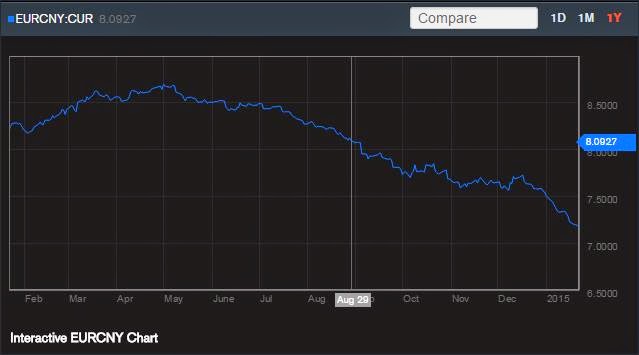
As we can see from this chart, the euro has fallen tremendously in the last year or so, from various other factors such as a weak European economy. The bond repurchasing program might have an interesting effect on its currency competitors. It might led to similar actions by the United States, by China, by the United Kingdom and other major central banks in order to promote export/import competitiveness. The start of Abenomics in Japan and this move by the European Central Bank has led to talk of more quantitative easing and more currency devaluations. I believe that the currency wars have just started between the major nations, while it will also lead to more people placing their assets into safe havens such as Switzerland. The Swiss might think twice about de-pegging their currency once again against these devalued major currencies...
(Here's a good and short summary article on the history of recent Swiss monetary history.)
Euro to US Dollar
Euro to Chinese Yuan
As we can see from this chart, the euro has fallen tremendously in the last year or so, from various other factors such as a weak European economy. The bond repurchasing program might have an interesting effect on its currency competitors. It might led to similar actions by the United States, by China, by the United Kingdom and other major central banks in order to promote export/import competitiveness. The start of Abenomics in Japan and this move by the European Central Bank has led to talk of more quantitative easing and more currency devaluations. I believe that the currency wars have just started between the major nations, while it will also lead to more people placing their assets into safe havens such as Switzerland. The Swiss might think twice about de-pegging their currency once again against these devalued major currencies...
(Here's a good and short summary article on the history of recent Swiss monetary history.)
Wednesday, January 21, 2015
Interesting article on the Chinese money supply and first day of the annual Davos World Economic Forum
I was just scrolling through the several blogs that I read every single day, which include the Marginal Revolution. I have found a very interesting article on the Chinese money supply that Tyler Cowen had posted as a blog earlier in the wee mornings on the first day of the annual World Economic Forum in Davos. The article was quite striking for two reasons:
1. The first reason was the point about the Chinese M2 money supply being 70% higher than the "rather tight" US money supply despite the much "smaller" size of the real Chinese economy versus the US economy. This is particularly interesting as it just shows how the much maligned Federal Reserve is actually more fiscally tight and conservative than their much more activist Chinese Central Bank counterparts. From what I gather, this might also be a false indicator of what the actual GDP growth in China is.
2. This is where my second reason for writing this thought bubble that I had about reading this particular blog that Tyler had written. From the Financial Times article that Tyler had posted in this blog entry, written by Derek Scissors from the American Enterprise Institute, we can conjecture that the Chinese economy will face an extremely rocky road in the coming years. It's a pretty cool article to check out, especially with his particularly interesting views. The Chinese economy might be in trouble in the short term, but I think it might still go pretty smoothly in the longer term.
It is also the first day of the annual Davos World Economic Forum! For those who are not familiar: The Davos meeting is the annual gathering of some of the world's most powerful economic elites, where they gather to discuss some of the pressing challenges that our world faces. It has been around for 40 something years and here are two articles that are worth reading about the contents of the meeting.
2012 New Yorker article
2015 The Guardian Opinion article
Interesting topics that these powerful people will discuss over the course of the meeting include increasing political instability, global income inequality, climate change, oil and their most pressing topic: financial instability! As many of us know about the rocky world economy and they will be discussing the financial instability that the world is currently/going to face in the coming years. The videos on the earlier World Economic Forum link that I had posted will hopefully interest those that might be interested in the World Economic Forum!
It's been a while since I've posted a blog entry, mainly because of other more urgent tasks that I had to handle this week. I will be posting lots of entries the next couple of days, as it is the exciting week of the World Economic Forum! I will be watching/following the events that unfold in the lovely Swiss resort city of Davos, Switzerland, but also I will be posting another blog post on thoughts about a rather marginal economic theory that I think has some relevance in the current economic turmoil.
1. The first reason was the point about the Chinese M2 money supply being 70% higher than the "rather tight" US money supply despite the much "smaller" size of the real Chinese economy versus the US economy. This is particularly interesting as it just shows how the much maligned Federal Reserve is actually more fiscally tight and conservative than their much more activist Chinese Central Bank counterparts. From what I gather, this might also be a false indicator of what the actual GDP growth in China is.
2. This is where my second reason for writing this thought bubble that I had about reading this particular blog that Tyler had written. From the Financial Times article that Tyler had posted in this blog entry, written by Derek Scissors from the American Enterprise Institute, we can conjecture that the Chinese economy will face an extremely rocky road in the coming years. It's a pretty cool article to check out, especially with his particularly interesting views. The Chinese economy might be in trouble in the short term, but I think it might still go pretty smoothly in the longer term.
It is also the first day of the annual Davos World Economic Forum! For those who are not familiar: The Davos meeting is the annual gathering of some of the world's most powerful economic elites, where they gather to discuss some of the pressing challenges that our world faces. It has been around for 40 something years and here are two articles that are worth reading about the contents of the meeting.
2012 New Yorker article
2015 The Guardian Opinion article
Interesting topics that these powerful people will discuss over the course of the meeting include increasing political instability, global income inequality, climate change, oil and their most pressing topic: financial instability! As many of us know about the rocky world economy and they will be discussing the financial instability that the world is currently/going to face in the coming years. The videos on the earlier World Economic Forum link that I had posted will hopefully interest those that might be interested in the World Economic Forum!
It's been a while since I've posted a blog entry, mainly because of other more urgent tasks that I had to handle this week. I will be posting lots of entries the next couple of days, as it is the exciting week of the World Economic Forum! I will be watching/following the events that unfold in the lovely Swiss resort city of Davos, Switzerland, but also I will be posting another blog post on thoughts about a rather marginal economic theory that I think has some relevance in the current economic turmoil.
Thursday, December 18, 2014
Russia Bankrupt and Will Collapse? Not so fast!
As many of you guys have been following the latest stories in the Western media about the great collapse of the Russian economy and Putin's tyrannical regime ending. I think these sensationalist remarks on how Russia is doomed to repeat the financial crisis of 1998 are just ridiculous. I mentioned in an earlier blog article about the dive in the value of the ruble is currently linked to the price of oil, but this doesn't mean Russia will always be like that. Since I'm a huge fan of graphical presentation of statistical data, here is the Bloomberg chart of the current situation here:
 This chart is Bloomberg's interactive RUBUSD (Russian Ruble to US dollar) interactive exchange rate chart and I have transposed the price of Brent Crude oil onto it. From the looks of this particular chart, it shows you how interconnected the Russian ruble US dollar exchange rates are with the price of crude oil on international energy markets.This illustration has been put on the Western news media and interpreted as a way to prove that the Russian economy is going to collapse. I believe that the Russian economy will definitely be hurt in the short term as they do not have fully diversified their economy beyond the natural resources as they are currently a rentier economy. A rentier economy is an economy of a state that mostly seeks to sell its natural resources to external economies. In Russia's case, they are not quite a rentier state due to the sheer size of the country's economy and its economic potential.
The Russian economy has a relatively developed economic infrastructure, a highly skilled economy and one of the largest natural resource bases of any country in the world. Articles like this illustrate the sheer potential of the Russian economy, so I think it's too early to say that the Russian economy will not recover in the medium to long term, much to the dismay of Western policymakers. As with every single set of information that is available out there, I believe it's important to take a holistic view of every single economic situation, especially this one.
The Russian economy has a relatively developed economic infrastructure, a highly skilled economy and one of the largest natural resource bases of any country in the world. Articles like this illustrate the sheer potential of the Russian economy, so I think it's too early to say that the Russian economy will not recover in the medium to long term, much to the dismay of Western policymakers. As with every single set of information that is available out there, I believe it's important to take a holistic view of every single economic situation, especially this one.
Friday, October 31, 2014
Swiss Referendum on Gold and its wider macro ramifications
An interesting development is coming out of Switzerland, home of pretty mountains and secretive banking. 100,000 Swiss voters have signed a referendum calling for the government to maintain what many call a "partial gold standard". This move requires the Switzerland National Bank to hold 20% of its monetary reserves in the shiny gold bullion. This is big news to anyone following money and government monetary policies, since the gold standard has been used many years in the past. The world financial system has not been actively connected to gold since a couple of years after the Nixon Shock with references to gold removed by a 1976 government decree.
There are several reasons why this referendum is also big news:
1. The recent huge surge in gold reserve purchases by Russia, by India and by China
2. Long term of gold and other currencies that challenge the supremacy of the US dollar as the future reserve currency
The question is if Russia and China are buying up a lot of gold, what are their central banks going to do? Are they diversifying away from using the dollar as a fiat backer of their reserves or are they trying to establish a partial gold standard? There has been speculation for years that the Chinese government working in tandem with the Chinese Central bank has been planning for a Gold-Backed Yuan. Alan Greenspan, who is no stranger to central banking and monetary policy, said recently in an Foreign Affairs article published last month seemed to hint at China's resurgent gold reserve policies that were of huge importance to that of the United States. What's interesting is that Alan Greenspan has come out recently and mentioned that he's worried about the future of monetary policy, but also that gold should be a "good place to put your money these days given its value as a currency outside of the policies conducted by the governments. These statements don't surprise any of us that have been following Alan Greenspan. This goes back to his earlier associations with Ayn Rand and her Objectivist collective that he had participated in, with him penning Gold and Economic Freedom in Ayn Rand's book, Capitalism, the Unknown Ideal. He must think of the massive quantitative easing that the Federal Reserve has undertaken and the impending currency crisis that the Federal Reserve will eventually face.
Where does this lead us to with the Swiss referendum? If the policies on the referendum pass the voters, it would have to go through the many cantons within the Swiss Confederation. If this vote can pass, it would have huge ramifications on the gold markets, the financial markets and the world fiat currency system. If countries that are much larger in scope and in size, like China or Russia, also adopted similar currency laws for their Central Bank, it would create enormous demand for gold, driving up gold prices, while decreasing worldwide demand for the current reserve, which is the US dollar. This vote could have significant macroeconomic ramifications for the world.
There are several reasons why this referendum is also big news:
1. The recent huge surge in gold reserve purchases by Russia, by India and by China
2. Long term of gold and other currencies that challenge the supremacy of the US dollar as the future reserve currency
The question is if Russia and China are buying up a lot of gold, what are their central banks going to do? Are they diversifying away from using the dollar as a fiat backer of their reserves or are they trying to establish a partial gold standard? There has been speculation for years that the Chinese government working in tandem with the Chinese Central bank has been planning for a Gold-Backed Yuan. Alan Greenspan, who is no stranger to central banking and monetary policy, said recently in an Foreign Affairs article published last month seemed to hint at China's resurgent gold reserve policies that were of huge importance to that of the United States. What's interesting is that Alan Greenspan has come out recently and mentioned that he's worried about the future of monetary policy, but also that gold should be a "good place to put your money these days given its value as a currency outside of the policies conducted by the governments. These statements don't surprise any of us that have been following Alan Greenspan. This goes back to his earlier associations with Ayn Rand and her Objectivist collective that he had participated in, with him penning Gold and Economic Freedom in Ayn Rand's book, Capitalism, the Unknown Ideal. He must think of the massive quantitative easing that the Federal Reserve has undertaken and the impending currency crisis that the Federal Reserve will eventually face.
Where does this lead us to with the Swiss referendum? If the policies on the referendum pass the voters, it would have to go through the many cantons within the Swiss Confederation. If this vote can pass, it would have huge ramifications on the gold markets, the financial markets and the world fiat currency system. If countries that are much larger in scope and in size, like China or Russia, also adopted similar currency laws for their Central Bank, it would create enormous demand for gold, driving up gold prices, while decreasing worldwide demand for the current reserve, which is the US dollar. This vote could have significant macroeconomic ramifications for the world.
Tuesday, October 21, 2014
Russia Ruble, Gold Reserve Purchases, Depressed Oil Prices
Russia's ruble has made financial news as of late, just as their conflict with their neighbor, Ukraine, has been frozen in the last month or so. Western sanctions have had a profound effect on Russia's monetary policy and the value of its currency, the ruble. According to the latest data, they have made another currency intervention by purchasing ruble from its mostly dollar-denominated currency reserves. This has been done to keep the ruble from falling even further down versus the US dollar, due to US and Western sanctions on key sectors of the Russian economy. This event coupled with falling oil prices have marked a perfect storm for Russia, but Russia has silently been buying up gold reserves. Does this mean that Russia will attempt to entirely decouple from the Western financial system? The answer is probably no, but they are slowly moving away from basing their international trade activities on the US dollar.
I have compiled two charts from Bloomberg that illustrate the falling ruble and the Russia's foreign exchange reserves, which includes gold.
 By looking at these Bloomberg charts, we can see that Russia's ruble has weakened from around 36 Russian rubles to one US dollar to about 41 to 1. There is sharp drop in the value of their currency, coupled with the sustained drop in their official foreign exchange and gold reserves from $500 billion dollars to about 450. While these official estimates might not be realistic, especially due to Russia's resurgent gold bullion purchases, they mark a country mired in recession due to Western sanctions and the costly war with Ukraine. Russia has emerged as officially the country with the 5th largest currency reserve in the world, which fuels speculation of their real motives. Along with China, Russia has been purchasing gold bullion at record amounts, could they be underestimating their real gold bullion numbers? We do know that their $13 billion worth of currency interventions this month shows real weakness in the value of their currency, but does this indicate that Russia is in a free-falling economy or does it have to do with Western sanctions? I think it has more to do with strongly falling oil prices since the ruble is, in my opinion, more or less a petro-ruble, similar to other petroleum-based currencies. This could change if they continue with their gold reserve purchases and changes in central bank policies. Could this be a gold-backed ruble?
By looking at the sudden drop oil prices, which reached a peak of about $105 (WTI) and $115 (Brent), oil has taken a sharp dive and prices hover around $82 (WTI) and $86 (Brent). This sharp correction has also influenced Russia's currency reserves and the price of its currency, which means sharp economic and budget problems for the Kremlin to handle. If this slide continues and coupled with more debt downgrades by S&P and Moody's, we could see Russia's currency sink further and will require more further currency interventions. Could we see Russia's central bankers make more aggressive monetary decisions regarding the state of its falling currency? In the future, there is very much reason to believe that they might discard SOME if not ALL of their US dollar-denominated assets. Could this also lead to a more politically and militarily belligerent Russia? We will have to wait and see what unfolds...
 |
By looking at the sudden drop oil prices, which reached a peak of about $105 (WTI) and $115 (Brent), oil has taken a sharp dive and prices hover around $82 (WTI) and $86 (Brent). This sharp correction has also influenced Russia's currency reserves and the price of its currency, which means sharp economic and budget problems for the Kremlin to handle. If this slide continues and coupled with more debt downgrades by S&P and Moody's, we could see Russia's currency sink further and will require more further currency interventions. Could we see Russia's central bankers make more aggressive monetary decisions regarding the state of its falling currency? In the future, there is very much reason to believe that they might discard SOME if not ALL of their US dollar-denominated assets. Could this also lead to a more politically and militarily belligerent Russia? We will have to wait and see what unfolds...
Friday, October 17, 2014
China's Growing Debt Since the Financial Crisis
An interesting article came up today when I was reading my usual couple of websites, which includes the Economist. This article concerned China's growing debt to GDP ratio that seemed to accelerate ever since the 2008 Financial Crisis. The growing debt seemed to be fueled by the growing credit boom, which has been further fueled by continued speculative construction. As the Chinese economy slows, most of this debt then increases to dangerously high levels, which is currently reaching at a level of above 200% of GDP. This number should be something to watch in the years down the road. The article doesn't mention much about the possible global implications for a possible meltdown, but if it does, I predict it could be worse than the 2008 Financial Crisis.
In another article that is connected to the other article, the piece gives us an idea of what the Chinese authorities could do to mitigate the inevitable. By looking at the chart that the article provided, most of this recent debt boom is from the credit-fueled continued construction bubble that is undertaken in China. The International Monetary Fund has warned repeatedly about the discerning possibility of a sharp and eventual Japan-style property meltdown. There could be many policies implemented in fixing this looming problem, but one of the main things that the international community and China could do is rein in the deep obsession with GDP growth and focus on other more important issues.
In another article that is connected to the other article, the piece gives us an idea of what the Chinese authorities could do to mitigate the inevitable. By looking at the chart that the article provided, most of this recent debt boom is from the credit-fueled continued construction bubble that is undertaken in China. The International Monetary Fund has warned repeatedly about the discerning possibility of a sharp and eventual Japan-style property meltdown. There could be many policies implemented in fixing this looming problem, but one of the main things that the international community and China could do is rein in the deep obsession with GDP growth and focus on other more important issues.
Wednesday, October 15, 2014
2014 IMF October 10-12 Meeting
The IMF held their annual meeting in October 10-12, 2014, the link to the meeting could be found here. On the opening day, the Managing Director of the IMF, Ms. Christine Lagarde talked about 3 key important factors that effected the world economy:
1. Acceleration and Stagnation
2. Stability or Fragility
3. Solidarity or Seclusion
Overall, her speech made a good point about how the member countries needed to come together like in 1944, not bicker over things like in 1914.
Other interesting speakers throughout the week included the World Bank President, Jim Yong Kim, Paul Krugman and other speakers. It also included a CNN Debate at the George Washington University. Overall, it featured excellent speakers on the issues that effected individual regions around the world. There are many critical issues which the world faces, but most importantly, the great thing about the Fund is that it helps to coordinate action among the 188 member countries.
1. Acceleration and Stagnation
2. Stability or Fragility
3. Solidarity or Seclusion
Overall, her speech made a good point about how the member countries needed to come together like in 1944, not bicker over things like in 1914.
Other interesting speakers throughout the week included the World Bank President, Jim Yong Kim, Paul Krugman and other speakers. It also included a CNN Debate at the George Washington University. Overall, it featured excellent speakers on the issues that effected individual regions around the world. There are many critical issues which the world faces, but most importantly, the great thing about the Fund is that it helps to coordinate action among the 188 member countries.
Saturday, October 11, 2014
China, Global Institutions and US Opposition
In a New York Times article that I had read 2 days ago, it described an interesting situation developing between China and the United States over the role of global and regional organizations. President Xi Jinping and the Chinese government had proposed and had pledged a new development bank that targets its neighbors and Asia. This is the latest manifestation of US-China competition within the great Asia-Pacific rim area, especially in the realm of global financial institutions.
Towards the end of World War 2, the Bretton Woods Conference had set up international financial institutions such as the International Monetary Fund, the World Bank and other associated agencies, such as the Asia Development Bank. With the surfeit of money that these agencies had, they have been doing good work around in the arena of global development. They had promoted doing good work in its provisions of global financial management, but now with the rise of China as a major financial player in the world, I believe there are needs to be addressed in this arena.
The US government has been worried that the founding of China's new development bank will severely undercut the Bretton Woods institutions that had been set up many years ago. I think this is a good opportunity for the institutions to work with each other. They can use the World Bank's experience and expertise coupled with China's newly minted financial strength in order to mitigate any misunderstanding, which could lead to mutually cooperative and constructive policies, versus mutually destructive competition. In the New York Times article, the Asian Development Bank had estimated that over 8 trillion dollars is needed in just transportation infrastructure, which is an amount that both the A.D.P. and the World Bank cannot afford to lend to these regions. I think it's time for the Obama administration and the US government to step up to the plate and to put a bigger commitment in mutually cooperative and beneficial policies.
Towards the end of World War 2, the Bretton Woods Conference had set up international financial institutions such as the International Monetary Fund, the World Bank and other associated agencies, such as the Asia Development Bank. With the surfeit of money that these agencies had, they have been doing good work around in the arena of global development. They had promoted doing good work in its provisions of global financial management, but now with the rise of China as a major financial player in the world, I believe there are needs to be addressed in this arena.
The US government has been worried that the founding of China's new development bank will severely undercut the Bretton Woods institutions that had been set up many years ago. I think this is a good opportunity for the institutions to work with each other. They can use the World Bank's experience and expertise coupled with China's newly minted financial strength in order to mitigate any misunderstanding, which could lead to mutually cooperative and constructive policies, versus mutually destructive competition. In the New York Times article, the Asian Development Bank had estimated that over 8 trillion dollars is needed in just transportation infrastructure, which is an amount that both the A.D.P. and the World Bank cannot afford to lend to these regions. I think it's time for the Obama administration and the US government to step up to the plate and to put a bigger commitment in mutually cooperative and beneficial policies.
Subscribe to:
Posts (Atom)