It has been a while since I have last posted here and I have been relatively busy the last couple of weeks. Here are the links to several interesting articles that I have been reading on top of the numerous economics journals and numerous other magazines I have been rummaging through the last couple of weeks:
1. An article by Steve Mufson in the Washington Post on possible Federal Reserve signals that a rate hike is possible. Here's another article on this particular subject written by John Cassidy of the New Yorker. It has been an interesting signal by the Federal Reserve, headed up by Janet Yellen, that they will eventually raise interest rates, but there are conflicted signals on what the economic outlook is. I forsee a not-so-great economic outlook at least for the next couple of quarters.
2. Matt Rognlie's thoughts on Thomas Piketty's observations posted on the Brookings Institution website. Quite an interesting article that he has written and here's the full copy of his work posted again on the Brookings Institution website. He is currently a PHD down the street from where I live at the Massachusetts Institute of Technology and in this article, he comes up with interesting data that somewhat backs up Thomas Piketty's thesis, but refutes it in the most part. He should be one economist to be followed in the coming years as he publishes more works.
3. A charming German couple goes to the former capital of Greece and pays off their portion of the "German World War 2 reparations" to Greece. This is quite a lovely move by the couple on a very serious issue of Greece threatening Germany with seizing German property if they do not pay long overdue World War 2 reparations, but it just shows the desperation of a completely bankrupt nation with no money left in the bank.
4. An interesting article that actually just came out on my news feed approximately 30 minutes ago. It talks about how debt will hit emerging economies. As predicted by an earlier blog post of mine, a potential economic crisis will start when some of these emerging economies see growth slow, debt accumulate and possible defaults happen.
Showing posts with label monetary policy. Show all posts
Showing posts with label monetary policy. Show all posts
Friday, March 20, 2015

Sunday, February 8, 2015
The Greek Debt Situation, the Troika, Syriza and Few Thoughts
As eyes of the world has turned towards the recent developments in Greece, I can admit that this will be an interesting period of time for Greece and the other member states of the European Union. Following the election of Syriza in the latest election, the leader of the Syriza party, Alex Tsipras, has promised the Greeks an end to the crippling austerity that the Greeks have faced ever since the start of the European debt crisis in 2009. The party aims to boost economic growth through stimulating the depressed Greek economy through Keynesian policies that will the new Syriza government promises to generate economic growth and to promote "social solidarity". What has really shocked the markets lately is Syriza's promise to stop negotiating with the Troika that consists the IMF, the European Central Bank and the European Union. The government has promised to return to the government-heavy policies of the past and to negotiate a write-off in Greek government debt. The decisive action in the economic and the political policies of the Marxists and the Keynesians that make up the intellectual leadership for the now ruling Syriza government has ran into a lot of controversy with the mainstream economic institutions that has been bailing out the Greek government and the Greek economy. In this particular blog post, I can hopefully explain the Greek situation in more details, but also impart my opinion on the state of this interesting situation that has been developing in Greece and the European Union.
Debt Situation Background and the Economic Crisis
The debt crisis in Greece had started even before the 2007-2008 Global Financial Crisis with the entrance of Greece into the Eurozone and the overspending that occurred during the Olympics was blamed for the current debt crisis that had its seeds all the way back in 2004. While the Olympic Games was one of the many financial debacles that the Greek government has had in the last two decades, I would say it compares nowhere to the other pressing problems that led up to their debt implosion that occurred after the Global Financial Crisis.
A combination of a corrupt government bureaucracy that struck shady back room deals, a culture of endemic tax evasion and a burdensome public sector led to one of the most serious debt crises that any country has faced. It has been said that the corruption of Greek officialdom led Greece into the Eurozone by utilizing the services of Goldman Sachs to make their debt situation comfortable enough for the not as corrupt European bureaucrats to let Greece into the European Union. The mistake of letting one of the most corrupt nations in Europe to enter the Eurozone was compounded by the fact that much of this debt could have avoided if Greece undertook an immense political restructuring program that changed the way politics in Greece had been operating. From the bribes that the officials had extracted from the Greek taxpayers in order to bribe corrupt European Union officials to the bribes that Greek political parties had handed out in public sector jobs led to one of the worst possible economic environments in all of Europe. The public also engaged in one of the most institutionalized tax evasion schemes in the world. Here are two articles that explain the tax evasion problem that had plagued Greece: One published by the Economist and another by the New Yorker. The Greeks had also simply been living way beyond their means for a long time with the government deficit financed growth and when the financial crisis had hit the country, the entire corrupt Greek political and economic system fell apart.
The US economic crisis caused a huge breakdown in the global debt pyramid that had partially relied on the US mortgage-backed securities for further growth. With the entire debt pyramid collapse, there it unleashed an onslaught of bad debt and bad loans. It triggered a tidal wave of debt crises around in Europe and the worst basket case example in the Hellenic country of Greece. Countries like Greece that had largely been living beyond their means through cheap interest rates that the Eurozone had brought. Through years of unnatural interest rates and a horribly mismanaged national economy, Greece paid the ultimate price for being in the same economic zone with countries like Germany. The Greeks had to be bailed out several times and here's an article from 2012 that described the situation in Greece 3 years ago.
The International Lenders and Greece
The 'Troika' of the International Monetary Fund, the European Union and the European Central Bank had to bailout certain failed European economies, but they also wanted these economies to restructure their economies based on the rules and the regulations of the IMF's "Washington Consensus". Here's an article by the English economist, Dr. John Williamson, which had coined that term as a way to disapprove of the policies that the IMF had implemented in many countries. In Greece, the Troika have demanded the exact same policies as John Williamson had lambasted in his article, especially when it comes to privatization of state industries. This leads to an interesting situation in Greece, where the bloated public sector has been connected to previous political election campaigns of both the major Greek parties as a way of institutionalizing corruption through vote purchasing. The anger of the crowds could be linked to these new policies which should have goals of liberating the Greek economy from the malaise of having an extremely unproductive and corrupt public sector. This has not really worked in Greece as it is very difficult to get rid of the old culture, plus the downward spiral of the Greek economy, which has been exacerbated by the cuts in benefits for ordinary citizens.
The crisis has caused tremendous hardship for many of the normal members of Greece with sharp increases in unemployment, cuts in state spending on welfare and on healthcare, reduction in the state infrastructure and a massive program of privatization. This has not just led to a breakdown in the Greek economy, but also numerous other social problems. Over 25% of Greeks are unemployed, with youth unemployment at 50% of above and many talented Greeks are moving out of Greece to find a more high-paying and desirable job within the Eurozone and in countries such as the United States. There has also been a tremendous breakdown in the normal social order, with countless people living on the streets, rummaging through trash cans to find out and the official poverty rate has increased to 45% by some estimates. Here's an extremely glaring chart that I found on Zero Hedge categorizing the tremendous poverty that has been accelerated acutely by the austerity that has been imposed on the Greece by the Troika:
 From this chart, we can talk about the very sharp and very acute increase in poverty that Greece has suffered ever since the start of the financial crisis. There has been reports of a huge resurgence of crime and lawlessness in Greece, which radical political groups such as the anarchists, the fascist Golden Dawn and some say, the current government, Syriza, have all seized the opportunity to increase their following. There have been countless numerous riots and incidents where there have been clashes between the different political elements in Greece. By browsing the internet and YouTube, you will be able to see these many incidents that has happened in a very unsettled and impoverished country. The radical leftists of the Syriza party have seized upon this crisis and by promoting an anti-austerity, pro-stimulus policy program, they have made the rest of the world look at that with a wary eye.
The Recent Election of Syriza and Current Situation
With the rather explosive situation in Greece, the radical leftists of the Syriza party was able to defeat the Troika's favored political party, the mainstream conservative party of the New Democracy. With this election of the Syriza, there has been a tremendous amount of both media coverage in what Alexis Tsipras and the radical Syriza might offer for the country. Here are two articles on Syriza: one that talks about the Syriza intellectuals that were educated in British universities and another on the roots of Alexis Tsipras. What's interesting from this particular situation is the clash between the leftist ideologues within the Syriza party, such as the Finance Minister, and the European finance and banking bureaucrats. Ever since the situation, Syriza has overturned many of the Troika's economic policies, such as the reduction of public sector workforce, the privatization of key publicly held companies and most importantly, they want to overturn the Troika's loan and debt policies. Alexis Tsipras has declared the end of the crippling austerity that the reforms have caused in Greece, but will face a tough battle and an intense clash with the authorities that have been dictating the terms of the Greek economy for the last 5-6 years.
Within the election of Syriza, financial markets at first reacted negatively to the possibility that Syriza would do great harm to the reform process that the Troika had implemented on the Greek economy, but now it has emerged that the European Central Bank will most likely dictate the terms to the Greek government. The Greek government had hoped to renegotiate the terms of the bailout package and the other economic terms that the Troika had implemented on Greece, but it looks like Alexis Tsipras and the Syriza have not completely backtracked from their strong anti-austerity rhetoric. Despite the fact that the European monetary authorities have a strong stranglehold on the Greek government's ability to operate as they had originally promised, they have found little common ground between them and the monetary authorities of countries like Germany. According to a recent article, Greece has been isolated in a previous meeting of finance ministers just before the Eurogroup meeting that will take place on Feb. 11th, which will be an important meeting in which the new Greek authorities will put forth a proposal that they want to be implemented in order to save their country from actually going bankrupt. With this meeting, Alexis Tsipras has just set up a clash with these ministers after laying out concrete plans to end the reforms that the Troika had implemented, especially the crippling austerity that has trapped millions of Greeks into long-term poverty. It will be a very interesting next couple of months for those who will be following how this interferes with the financial markets.
Possible Results and Possible Macroeconomic Effects
I believe that a Greek default and a Grexit of the euro are both entirely impossible. A more realistic solution to this confrontation is a negotiated write-offs of small amounts of Greek debt, while still not solving the problems in the structure of the economic institutions within Greece. Greece will still be continued to be saddled with massive public debt, institutional corruption and an extremely inefficient public sector. To improve the situation in Greece, there must be a change in how Greece functions as a democratic country. There needs to be more transparency in how the bureaucracy is managed, as debts could be potentially saved without resorting to drastic privatization or the massive public sector layoffs. I still don't believe that the institutional corruption or the entrenched political interests within Greece could be fixed overnight, since the new Syriza government wants a return to the statist government that promotes 'social justice' versus an economic model that promotes business growth. I believe that they will be able to get some debt concessions, but it does not address the long-term debt issues that Greece will have to face. The new Syriza government and the European monetary authorities will most likely end up kicking the can down the road.
There are many possible solutions and results that could come from this particular and interesting situation that Greece is facing, not just against its creditors, the Troika and the financial markets, but also against the underlying principles of liberal economics that has been prevalent throughout the world since the 1980s. There has been a resurgence of a previous dominant Keynesian thought in economic thought that has expanded beyond the confines of the New Keynesians and the followers of Paul Samuelson's neoclassical synthesis. I believe the election of Syriza in Greece will continue to trigger the resurgence of left Keynesian economic thought throughout the world, but also other left wing alternatives that might spurn the IMF's Washington Consensus and the general Monetarist and New Keynesian approaches to economic policy. I also believe we could potentially see the development of new economic models to explain the problems that countries such as Greece went through. Maybe there are possible solutions that could be utilized without the pitched ideological battles that has raged within the European community and beyond. I think there are a tremendous sets of new data that could be extrapolated from this particular situation and that data could be analyzed from the resulting resolution to the Greek crisis.
Debt Situation Background and the Economic Crisis
The debt crisis in Greece had started even before the 2007-2008 Global Financial Crisis with the entrance of Greece into the Eurozone and the overspending that occurred during the Olympics was blamed for the current debt crisis that had its seeds all the way back in 2004. While the Olympic Games was one of the many financial debacles that the Greek government has had in the last two decades, I would say it compares nowhere to the other pressing problems that led up to their debt implosion that occurred after the Global Financial Crisis.
A combination of a corrupt government bureaucracy that struck shady back room deals, a culture of endemic tax evasion and a burdensome public sector led to one of the most serious debt crises that any country has faced. It has been said that the corruption of Greek officialdom led Greece into the Eurozone by utilizing the services of Goldman Sachs to make their debt situation comfortable enough for the not as corrupt European bureaucrats to let Greece into the European Union. The mistake of letting one of the most corrupt nations in Europe to enter the Eurozone was compounded by the fact that much of this debt could have avoided if Greece undertook an immense political restructuring program that changed the way politics in Greece had been operating. From the bribes that the officials had extracted from the Greek taxpayers in order to bribe corrupt European Union officials to the bribes that Greek political parties had handed out in public sector jobs led to one of the worst possible economic environments in all of Europe. The public also engaged in one of the most institutionalized tax evasion schemes in the world. Here are two articles that explain the tax evasion problem that had plagued Greece: One published by the Economist and another by the New Yorker. The Greeks had also simply been living way beyond their means for a long time with the government deficit financed growth and when the financial crisis had hit the country, the entire corrupt Greek political and economic system fell apart.
The US economic crisis caused a huge breakdown in the global debt pyramid that had partially relied on the US mortgage-backed securities for further growth. With the entire debt pyramid collapse, there it unleashed an onslaught of bad debt and bad loans. It triggered a tidal wave of debt crises around in Europe and the worst basket case example in the Hellenic country of Greece. Countries like Greece that had largely been living beyond their means through cheap interest rates that the Eurozone had brought. Through years of unnatural interest rates and a horribly mismanaged national economy, Greece paid the ultimate price for being in the same economic zone with countries like Germany. The Greeks had to be bailed out several times and here's an article from 2012 that described the situation in Greece 3 years ago.
The International Lenders and Greece
The 'Troika' of the International Monetary Fund, the European Union and the European Central Bank had to bailout certain failed European economies, but they also wanted these economies to restructure their economies based on the rules and the regulations of the IMF's "Washington Consensus". Here's an article by the English economist, Dr. John Williamson, which had coined that term as a way to disapprove of the policies that the IMF had implemented in many countries. In Greece, the Troika have demanded the exact same policies as John Williamson had lambasted in his article, especially when it comes to privatization of state industries. This leads to an interesting situation in Greece, where the bloated public sector has been connected to previous political election campaigns of both the major Greek parties as a way of institutionalizing corruption through vote purchasing. The anger of the crowds could be linked to these new policies which should have goals of liberating the Greek economy from the malaise of having an extremely unproductive and corrupt public sector. This has not really worked in Greece as it is very difficult to get rid of the old culture, plus the downward spiral of the Greek economy, which has been exacerbated by the cuts in benefits for ordinary citizens.
The crisis has caused tremendous hardship for many of the normal members of Greece with sharp increases in unemployment, cuts in state spending on welfare and on healthcare, reduction in the state infrastructure and a massive program of privatization. This has not just led to a breakdown in the Greek economy, but also numerous other social problems. Over 25% of Greeks are unemployed, with youth unemployment at 50% of above and many talented Greeks are moving out of Greece to find a more high-paying and desirable job within the Eurozone and in countries such as the United States. There has also been a tremendous breakdown in the normal social order, with countless people living on the streets, rummaging through trash cans to find out and the official poverty rate has increased to 45% by some estimates. Here's an extremely glaring chart that I found on Zero Hedge categorizing the tremendous poverty that has been accelerated acutely by the austerity that has been imposed on the Greece by the Troika:

The Recent Election of Syriza and Current Situation
With the rather explosive situation in Greece, the radical leftists of the Syriza party was able to defeat the Troika's favored political party, the mainstream conservative party of the New Democracy. With this election of the Syriza, there has been a tremendous amount of both media coverage in what Alexis Tsipras and the radical Syriza might offer for the country. Here are two articles on Syriza: one that talks about the Syriza intellectuals that were educated in British universities and another on the roots of Alexis Tsipras. What's interesting from this particular situation is the clash between the leftist ideologues within the Syriza party, such as the Finance Minister, and the European finance and banking bureaucrats. Ever since the situation, Syriza has overturned many of the Troika's economic policies, such as the reduction of public sector workforce, the privatization of key publicly held companies and most importantly, they want to overturn the Troika's loan and debt policies. Alexis Tsipras has declared the end of the crippling austerity that the reforms have caused in Greece, but will face a tough battle and an intense clash with the authorities that have been dictating the terms of the Greek economy for the last 5-6 years.
Within the election of Syriza, financial markets at first reacted negatively to the possibility that Syriza would do great harm to the reform process that the Troika had implemented on the Greek economy, but now it has emerged that the European Central Bank will most likely dictate the terms to the Greek government. The Greek government had hoped to renegotiate the terms of the bailout package and the other economic terms that the Troika had implemented on Greece, but it looks like Alexis Tsipras and the Syriza have not completely backtracked from their strong anti-austerity rhetoric. Despite the fact that the European monetary authorities have a strong stranglehold on the Greek government's ability to operate as they had originally promised, they have found little common ground between them and the monetary authorities of countries like Germany. According to a recent article, Greece has been isolated in a previous meeting of finance ministers just before the Eurogroup meeting that will take place on Feb. 11th, which will be an important meeting in which the new Greek authorities will put forth a proposal that they want to be implemented in order to save their country from actually going bankrupt. With this meeting, Alexis Tsipras has just set up a clash with these ministers after laying out concrete plans to end the reforms that the Troika had implemented, especially the crippling austerity that has trapped millions of Greeks into long-term poverty. It will be a very interesting next couple of months for those who will be following how this interferes with the financial markets.
Possible Results and Possible Macroeconomic Effects
I believe that a Greek default and a Grexit of the euro are both entirely impossible. A more realistic solution to this confrontation is a negotiated write-offs of small amounts of Greek debt, while still not solving the problems in the structure of the economic institutions within Greece. Greece will still be continued to be saddled with massive public debt, institutional corruption and an extremely inefficient public sector. To improve the situation in Greece, there must be a change in how Greece functions as a democratic country. There needs to be more transparency in how the bureaucracy is managed, as debts could be potentially saved without resorting to drastic privatization or the massive public sector layoffs. I still don't believe that the institutional corruption or the entrenched political interests within Greece could be fixed overnight, since the new Syriza government wants a return to the statist government that promotes 'social justice' versus an economic model that promotes business growth. I believe that they will be able to get some debt concessions, but it does not address the long-term debt issues that Greece will have to face. The new Syriza government and the European monetary authorities will most likely end up kicking the can down the road.
There are many possible solutions and results that could come from this particular and interesting situation that Greece is facing, not just against its creditors, the Troika and the financial markets, but also against the underlying principles of liberal economics that has been prevalent throughout the world since the 1980s. There has been a resurgence of a previous dominant Keynesian thought in economic thought that has expanded beyond the confines of the New Keynesians and the followers of Paul Samuelson's neoclassical synthesis. I believe the election of Syriza in Greece will continue to trigger the resurgence of left Keynesian economic thought throughout the world, but also other left wing alternatives that might spurn the IMF's Washington Consensus and the general Monetarist and New Keynesian approaches to economic policy. I also believe we could potentially see the development of new economic models to explain the problems that countries such as Greece went through. Maybe there are possible solutions that could be utilized without the pitched ideological battles that has raged within the European community and beyond. I think there are a tremendous sets of new data that could be extrapolated from this particular situation and that data could be analyzed from the resulting resolution to the Greek crisis.
Wednesday, January 28, 2015
Thoughts on this week's World Economic Forum in Davos
Like many around the world, I have been following this year's World Economic Forum in Davos, Switzerland. As I described in a previous blog post, lots of pressing issues are discussed among the leading policymakers from around the world. I mentioned the key points to this year's meeting and it includes many of the pressing issues that we as a world have to face today. Here is the link to the key moments that had happened during this year's World Economic Forum. From what I gather, this year is the year where a combination of low energy prices, terrorism, growing income inequality and a looming economic malaise surround the world at large. I believe the people at this particular conference talked about some of these pertinent issues and they have overall tackled some of the more pressing issues. These issues are very indeed alarming and I believe some of these issues can be tackled without the "action" that some of the conference attendees have come up with.
Thoughts on the key points of the yearly conference:
1. Reduce inequality, but to promote growth
The most pressing issue around the world is the growing inequality that has been prominent in world headlines and in numerous discussions between economists. As Thomas Piketty's book has reached its popularity around the world, numerous other economists and many politicians around the world has mentioned that this was a huge issue that needed to be tackled. There have been tremendous amounts of press coverage in the last couple of years towards this particular subject and the people at the forum have talked about various ways to tackle this pressing issue. Sustainable growth is something that the people at the forum have talked about as a possible resolution to the most critical issue presented at this particular conference. I believe that while it is possible to reduce inequality through promoting growth, it is also important to consider other possible solutions such as structural reform of key institutions and of how certain private institutions could function within the confines of society. It's interesting to note that while some solutions are offered, I believe there should be more radical solutions such as that posited by Piketty's Capital in the Twenty First Century than the more conservative ones mentioned at the forum.
Here are a couple of video links to certain conversations at the forum that concern this particular problematic issue and other related issues: The World Economic Outlook, IMF Director Christine Lagarde's Address, Issue Briefing: Income Inequality, BBC World Debate.
2. Europe's Quantitative Easing program
As announced in a previous post, the European Central Bank has announced a new massive quantitative easing program of over a trillion that will be pumped into the European economy. There has been a lot of discussion over this particular policy decision by the panel discussants at the forum, by top economists such as Robert J. Shiller, by the top bloggers and with some of my friends. As mentioned in a previous blog posts, there has been a tremendous controversy over this particular issue, with numerous speakers giving their particular opinion on the particular issue. Here's a list of quotes by key forum speakers and here's a video on the discussion of the effects of quantitative easing in the United States and beyond. Here are two contrasting opinion articles on the effects of quantitative easing, one from Professor Jeffrey Sachs and another from Stephen S. Roach. With this particular problem that has already been implemented by Mario Draghi, I believe it is important for them to promote these particular policies, even though there might be strong negative consequences that come from this round of quantitative easing, such as a combination of weak growth and of higher inflation that might come from this monetary policy, but we will have to wait and see.
3. Energy Prices
I think the recent drop in energy prices have been affecting everyone domestically here in the United States and globally around the world. Energy consumers have been given a break in the recent drop in petroleum prices, but energy producers have hit a wall. Countries such as Russia, Iran, Iraq, Venezuela and others will suffer tremendously in the coming years, which might contribute to significant political instability. I mentioned in an earlier blog post about Russia's internal and external problems, which I think will compound in the coming years. This will see a surge in Russia's more aggressive and nationalistic foreign policy. The oil producers will see significant domestic problems, which were already tremendous in volume, expand rapidly throughout the Middle East. We could see trouble in the coming years with this drop in oil prices because it cause an acute global recession.
Here's a video of an interesting panel discussion during the conference that concerned energy.
4. Market Volatility
The last important point that the people at the forum have made concerned with the issue of market volatility. The markets have been very volatile over the years since the Great Recession with the recent drop in energy prices and the global stock market rallies been at the forefront of discussion.
Here are a couple of discussions that deal with this pressing issue: Volatility as the New Normal, The New Growth Context.
Other Important Points:
1. China
A couple of key panel discussants talked about China at this year's conference, which included the Chinese Premier, Li Keqiang. As mentioned in a previous paragraph, he was one of the first to talk about the income inequality issue in an address to the Forum. China has tremendous challenges when it comes to its economy and its new role in the global economy, but I think it can be a tremendous benefit to the world to more fully incorporate a nation of China's size into the world economy. Here are two videos that address the issue of China in the world: Video of Premier Li Keqiang's Speech and China's Impact as a Global Investor.
2. Al Gore and Climate Change
There was a discussion by Al Gore and another discussion throughout the 4 day conference that concerned the topic of climate change. As many have watched Al Gore's documentary and other documentaries that have talked about the pressing issue of climate change, we can conclude that this is one of the more important topics talked among conference participants and conference followers. These two discussions presents the views of many that concerned this particular issue, with several others chiming in on the discussion. I think there are a tremendous number of economic issues that we will run into if we implement Al Gore's plan to combat climate change. I believe the biggest issue has to deal with the continued development of emerging economies and with the issue of lifting billions of individuals, while simultaneously counteracting this increase in carbon emissions and in pollution.
3. Conflict zones
There were a tremendous number of discussions that dealt with the increasing number of conflicts that have developed in the world, which include a variety of countries. This included actual military conflicts such as those in Syria, Ukraine and Iraq along with competing geopolitical games that larger powers are always conducting. The key discussion in this particular subject is that of the development of a new multi-polar world, which always had potentially dangerous consequences. This also leads us to the question of the viability of the democratic institutions, which has been the landmark of industrialized Western countries such as the United States. Is the end of history as describe by Francis Fukuyama not possible or is it a new chapter in history? We will have to wait and find out what unfolds in the coming years.
There were a lot of great panel discussions over the course of these 4 days in Davos. Despite the amount of content that was covered at this year's edition of the World Economic Forum, there are many economic (and political) issues that are still yet to be discussed. With the interesting economic and monetary situation unfolding in Europe and in Greece, we will have to wait and see what unravels.
Thoughts on the key points of the yearly conference:
1. Reduce inequality, but to promote growth
The most pressing issue around the world is the growing inequality that has been prominent in world headlines and in numerous discussions between economists. As Thomas Piketty's book has reached its popularity around the world, numerous other economists and many politicians around the world has mentioned that this was a huge issue that needed to be tackled. There have been tremendous amounts of press coverage in the last couple of years towards this particular subject and the people at the forum have talked about various ways to tackle this pressing issue. Sustainable growth is something that the people at the forum have talked about as a possible resolution to the most critical issue presented at this particular conference. I believe that while it is possible to reduce inequality through promoting growth, it is also important to consider other possible solutions such as structural reform of key institutions and of how certain private institutions could function within the confines of society. It's interesting to note that while some solutions are offered, I believe there should be more radical solutions such as that posited by Piketty's Capital in the Twenty First Century than the more conservative ones mentioned at the forum.
Here are a couple of video links to certain conversations at the forum that concern this particular problematic issue and other related issues: The World Economic Outlook, IMF Director Christine Lagarde's Address, Issue Briefing: Income Inequality, BBC World Debate.
2. Europe's Quantitative Easing program
As announced in a previous post, the European Central Bank has announced a new massive quantitative easing program of over a trillion that will be pumped into the European economy. There has been a lot of discussion over this particular policy decision by the panel discussants at the forum, by top economists such as Robert J. Shiller, by the top bloggers and with some of my friends. As mentioned in a previous blog posts, there has been a tremendous controversy over this particular issue, with numerous speakers giving their particular opinion on the particular issue. Here's a list of quotes by key forum speakers and here's a video on the discussion of the effects of quantitative easing in the United States and beyond. Here are two contrasting opinion articles on the effects of quantitative easing, one from Professor Jeffrey Sachs and another from Stephen S. Roach. With this particular problem that has already been implemented by Mario Draghi, I believe it is important for them to promote these particular policies, even though there might be strong negative consequences that come from this round of quantitative easing, such as a combination of weak growth and of higher inflation that might come from this monetary policy, but we will have to wait and see.
3. Energy Prices
I think the recent drop in energy prices have been affecting everyone domestically here in the United States and globally around the world. Energy consumers have been given a break in the recent drop in petroleum prices, but energy producers have hit a wall. Countries such as Russia, Iran, Iraq, Venezuela and others will suffer tremendously in the coming years, which might contribute to significant political instability. I mentioned in an earlier blog post about Russia's internal and external problems, which I think will compound in the coming years. This will see a surge in Russia's more aggressive and nationalistic foreign policy. The oil producers will see significant domestic problems, which were already tremendous in volume, expand rapidly throughout the Middle East. We could see trouble in the coming years with this drop in oil prices because it cause an acute global recession.
Here's a video of an interesting panel discussion during the conference that concerned energy.
4. Market Volatility
The last important point that the people at the forum have made concerned with the issue of market volatility. The markets have been very volatile over the years since the Great Recession with the recent drop in energy prices and the global stock market rallies been at the forefront of discussion.
Here are a couple of discussions that deal with this pressing issue: Volatility as the New Normal, The New Growth Context.
Other Important Points:
1. China
A couple of key panel discussants talked about China at this year's conference, which included the Chinese Premier, Li Keqiang. As mentioned in a previous paragraph, he was one of the first to talk about the income inequality issue in an address to the Forum. China has tremendous challenges when it comes to its economy and its new role in the global economy, but I think it can be a tremendous benefit to the world to more fully incorporate a nation of China's size into the world economy. Here are two videos that address the issue of China in the world: Video of Premier Li Keqiang's Speech and China's Impact as a Global Investor.
2. Al Gore and Climate Change
There was a discussion by Al Gore and another discussion throughout the 4 day conference that concerned the topic of climate change. As many have watched Al Gore's documentary and other documentaries that have talked about the pressing issue of climate change, we can conclude that this is one of the more important topics talked among conference participants and conference followers. These two discussions presents the views of many that concerned this particular issue, with several others chiming in on the discussion. I think there are a tremendous number of economic issues that we will run into if we implement Al Gore's plan to combat climate change. I believe the biggest issue has to deal with the continued development of emerging economies and with the issue of lifting billions of individuals, while simultaneously counteracting this increase in carbon emissions and in pollution.
3. Conflict zones
There were a tremendous number of discussions that dealt with the increasing number of conflicts that have developed in the world, which include a variety of countries. This included actual military conflicts such as those in Syria, Ukraine and Iraq along with competing geopolitical games that larger powers are always conducting. The key discussion in this particular subject is that of the development of a new multi-polar world, which always had potentially dangerous consequences. This also leads us to the question of the viability of the democratic institutions, which has been the landmark of industrialized Western countries such as the United States. Is the end of history as describe by Francis Fukuyama not possible or is it a new chapter in history? We will have to wait and find out what unfolds in the coming years.
There were a lot of great panel discussions over the course of these 4 days in Davos. Despite the amount of content that was covered at this year's edition of the World Economic Forum, there are many economic (and political) issues that are still yet to be discussed. With the interesting economic and monetary situation unfolding in Europe and in Greece, we will have to wait and see what unravels.
Thursday, January 22, 2015
Beginning of escalation of a currency war between Europe and the rest of the world?
The European Central Bank's upcoming quantitative easing plans has been headline business news for the last couple of days, but today the ECB has finally announced the measures that they will pursue in the coming months. has decided to pursue very aggressive easing policies that will surely affect the markets for the coming years. In pursuing an aggressive bond repurchasing program of upwards of 60 million euros per month, the ECB hopes to curb deflation that has hit the European Union's economy. In the introduction statement to the press conference, the President of the ECB, Mario Draghi, has decided to explain these particular measures. Draghi mentioned that the ECB wants this process to continue until they can reach the benchmark inflation rate of 2% in the European Union and that these measures will continue until the end of 2016. To fully understand the full consequences of this program, we can relay to my last article where I had mentioned the massive expansion of the Chinese M2 money supply. I think it will create a tsunami flood of cheap money that will flood the markets, which will further decrease the value of the euro versus other major currencies. Here are several charts that feature euro versus the two other major currencies.
Euro to US Dollar

Euro to Chinese Yuan
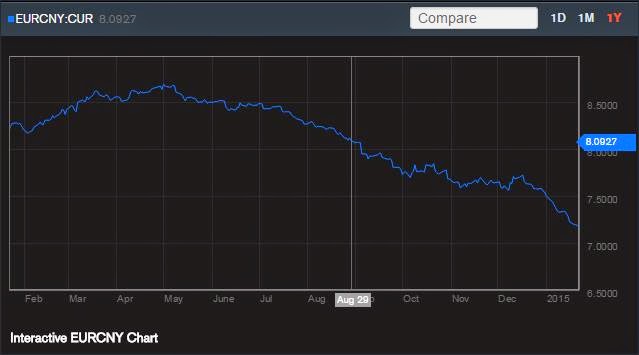
As we can see from this chart, the euro has fallen tremendously in the last year or so, from various other factors such as a weak European economy. The bond repurchasing program might have an interesting effect on its currency competitors. It might led to similar actions by the United States, by China, by the United Kingdom and other major central banks in order to promote export/import competitiveness. The start of Abenomics in Japan and this move by the European Central Bank has led to talk of more quantitative easing and more currency devaluations. I believe that the currency wars have just started between the major nations, while it will also lead to more people placing their assets into safe havens such as Switzerland. The Swiss might think twice about de-pegging their currency once again against these devalued major currencies...
(Here's a good and short summary article on the history of recent Swiss monetary history.)
Euro to US Dollar
Euro to Chinese Yuan
As we can see from this chart, the euro has fallen tremendously in the last year or so, from various other factors such as a weak European economy. The bond repurchasing program might have an interesting effect on its currency competitors. It might led to similar actions by the United States, by China, by the United Kingdom and other major central banks in order to promote export/import competitiveness. The start of Abenomics in Japan and this move by the European Central Bank has led to talk of more quantitative easing and more currency devaluations. I believe that the currency wars have just started between the major nations, while it will also lead to more people placing their assets into safe havens such as Switzerland. The Swiss might think twice about de-pegging their currency once again against these devalued major currencies...
(Here's a good and short summary article on the history of recent Swiss monetary history.)
Subscribe to:
Posts (Atom)